
A Rare Gourd
- NASA’s Hubble Space Telescope captured an image of the Calabash Nebula, showing the death of a low-mass star.
- The star is undergoing a rapid transformation from a red giant to a planetary nebula, expelling its outer layers into space.
- The ejected material is moving at incredible speeds, with gas shown in yellow traveling close to 1 million kilometers per hour.
- This event is rare for astronomers to capture, as it occurs within a very short time frame (the “blink of an eye” in astronomical terms).
- Over the next thousand years, the nebula will evolve into a fully-fledged planetary nebula, providing valuable insights into stellar evolution and the life cycle of stars.
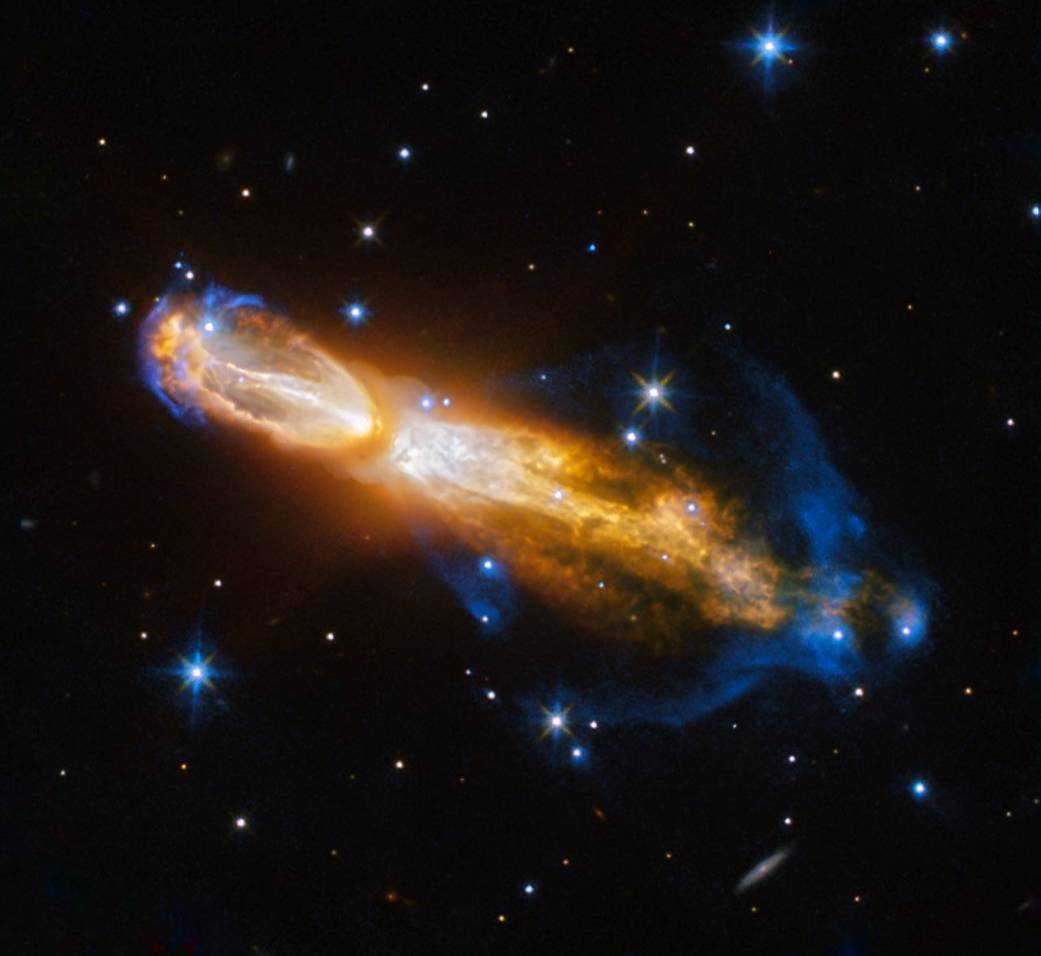
Image credit: ESA/Hubble & NASA; Acknowledgement: Judy Schmidt
NASA’s Hubble Space Telescope captured an uncommon sight – the death of a low-mass star – in this image of the Calabash Nebula released on Feb. 3, 2017.
Here, we can see the star going through a rapid transformation from a red giant to a planetary nebula, during which it blows its outer layers of gas and dust out into the surrounding space. The recently ejected material is spat out in opposite directions with immense speed — the gas shown in yellow is moving close to a million kilometers an hour.
Astronomers rarely capture a star in this phase of its evolution because it occurs within the blink of an eye – in astronomical terms. Over the next thousand years the nebula is expected to evolve into a fully-fledged planetary nebula.
Q. What is the name of the nebula captured by NASA’s Hubble Space Telescope?
A. The Calabash Nebula.
Q. How fast is the gas shown in yellow moving in the image?
A. The gas is moving at close to a million kilometers an hour.
Q. Why do astronomers rarely capture a star in this phase of its evolution?
A. Because it occurs within the blink of an eye – in astronomical terms, over a period of just a thousand years.
Q. What happens to the nebula over the next thousand years after the star’s transformation?
A. The nebula is expected to evolve into a fully-fledged planetary nebula.
Q. How does the recently ejected material from the star move out into space?
A. It is spat out in opposite directions with immense speed.
Q. What type of object is the Calabash Nebula?
A. A planetary nebula.
Q. When was the image of the Calabash Nebula released by NASA’s Hubble Space Telescope?
A. February 3, 2017.
Q. Who provided the acknowledgement for the image credit?
A. Judy Schmidt.
Q. What is the significance of the star going through this rapid transformation?
A. It shows the death of a low-mass star and its subsequent transformation into a planetary nebula.
Q. How long does it take for the nebula to evolve into a fully-fledged planetary nebula?
A. Over the next thousand years.