
Climate change is to blame for disappearing rains in the southwest
- Climate change is the primary cause of the drought in the southwest US, particularly in the Colorado River Basin, which has been experiencing historic low precipitation levels since 1999.
- The warming trend and reduced winter snowfall are major contributors to the drought, with long-term research indicating that there will be more dry winters than wet winters due to climate change.
- Researchers Jonathan Overpeck and Brad Udall have concluded that human activities driving climate change are responsible for the downward precipitation trend in the region, which is unlikely to rebound until action is taken to address climate change.
- The Colorado River Basin requires a natural flow of 16.5 million acre-feet to comfortably provide adequate water, but it is currently at 12 million acre-feet, highlighting the urgent need for action to mitigate the effects of climate change.
- Udall emphasizes that the climate-water connection is global in importance, with droughts enabling more devastating wildfires and storms carrying more water leading to more dangerous floods if greenhouse gas emissions are not limited to international targets like those set by the Paris Agreement.
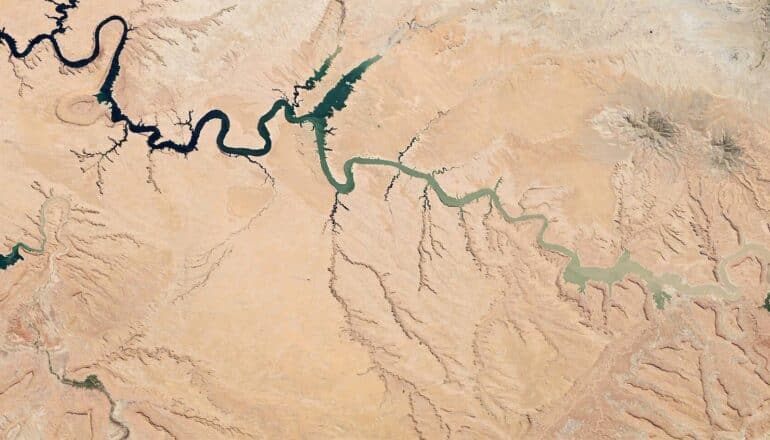
The southwest’s disappearing precipitation is due to human-driven climate change, according to a new report.
The Colorado River Basin, like much of the southwestern US, is experiencing a drought so historic—it began in 1999—that it’s been called a megadrought. In the basin, whose river provides water to seven states and Mexico, that drought is the product of warming temperatures and reduced precipitation, especially in the form of winter snow.
While the warming trend has been conclusively linked to the human activities driving climate change, the cause of the waning precipitation wasn’t as clear. Now, however, Jonathan Overpeck of the University of Michigan and Brad Udall of the Colorado Water Center at Colorado State University are convinced that anthropogenic climate change is the culprit as well.
“The drought’s been going on for over 25 years and there’s been a real downward trend in precipitation. But, even as recently as a year ago, we thought that just might be part of the natural variability—we figured the precipitation might turn around,” says Overpeck, the dean of the UM School for Environment and Sustainability.
“Within the last year, there’s been research that tells us pretty convincingly that’s not the case. Longterm, there are going to be more dry winters than wet winters and that’s due to climate change.”
Starting with a cornerstone 2017 study, Udall and Overpeck have been detailing the state of the drought and its climate drivers with a series of graphs that use the best data and science available. In this year’s update to the graphs, published as part of a larger annual report just released by the Colorado River Research Group, the duo came to two conclusions. One, the downward precipitation trend is also due to human activity and, two, it’s unlikely to rebound until we do something about it.
“Because we understand the cause of the decline in precipitation and the increase in temperature, we know how to stop it. We just have to stop climate change. No big deal, right?” Overpeck says. “But we know how to stop it, we have the solutions, and it’s not too late to stop it.”
The duo says that having an extra year of data helped reach these conclusions, but the key development was the publication of two new studies in the field of climate science. One study, led by Jeremy Klavans of the University of Colorado, Boulder, helped improve climate models used to study the region. The second study, led by Victoria Todd of the University of Texas at Austin, used paleoclimatology techniques to reveal trends in temperatures from thousands of years ago to provide critical context for the current scenario.
Taken together, this led Udall and Overpeck to issue a reality check as the title for their contribution to the annual Colorado River Basin report: “Think Natural Flows Will Rebound in the Colorado River Basin? Think Again.” To comfortably provide adequate water for the basin, the natural flow of the Colorado River should be at 16.5 million acre-feet, roughly the volume of 8 million Olympic sized pools, Overpeck says. It is currently closer to 12 million acre-feet.
Both Udall and Overpeck stressed there is natural variability and there will be wetter winters and dryer winters year to year. Their findings point to the long-term outlook being dryer overall, however. That says, the near-term outlook isn’t great either, Udall says.
“We’ve basically taken the buffer out of the system. We’ve burned through all this reservoir storage over the past 26 years and we’re one dry winter away from having very serious water usage cuts being enforced in a way that has never occurred before,” Udall says. “And this winter is not starting off on a good foot.”
People often ask Udall what happens if we don’t limit greenhouse gas emissions and the warming of the average global temperature to international targets, like those set by the Paris Agreement. This precarious situation is one of the answers. While farmers and water managers in the region are acutely aware of the stakes, he says, the climate-water connection is of global importance. Droughts are enabling more devastating wildfires, while storms are carrying more water leading to more dangerous floods.
“This supercharging of the hydrological cycle is the story of climate change, in my mind. Climate change is water change,” Udall says. “We control our own destiny here, but we’re not controlling it right now.”
Source: University of Michigan
The post Climate change is to blame for disappearing rains in the southwest appeared first on Futurity.