
I study rat nests − here’s why rodents make great archivists
- Rat nests can serve as archives for materials that have been undisturbed for hundreds of years, providing valuable insights into the lives of past inhabitants.
- Archaeologists like the author study rat nests to learn about the food, medicine, and trade practices of historical communities, such as the Bartram family in 18th-century Philadelphia.
- The author analyzed a rat nest from the historic home at Bartram’s Garden, which revealed a diverse range of plants collected by rats over several decades, including crops, herbs, and wild plants.
- By studying these plant materials, the author gained insights into the family’s diet, medicine, and trade practices, as well as the introduction of invasive species in the United States.
- The study highlights the importance of rat nests as a resource for archaeobotanists, who can use them to reconstruct the past and better understand historical ecosystems and human interactions with the environment.

Rats and other rodents and pests can make great archivists.
That’s because they forage food and build dens, storing fabric, paper, animal bones, plant remains and other materials under floorboards, behind walls and in attics, crawl spaces and wells. There, these materials might dry out and remain undisturbed for hundreds of years.
By analyzing the materials in these nests, archaeologists like me can learn more about the people who once lived nearby.
I studied a rat nest that was used by generations of rats over several decades and was found under the floorboards in the attic of the historic home at Bartram’s Garden in southwest Philadelphia. In 1728, Quaker farmer and naturalist John Bartram began to plant his garden, which is considered the oldest botanic garden in North America. I studied thousands of plants collected by rats and learned how the Bartram family used these plants for food, medicine, trade and study.
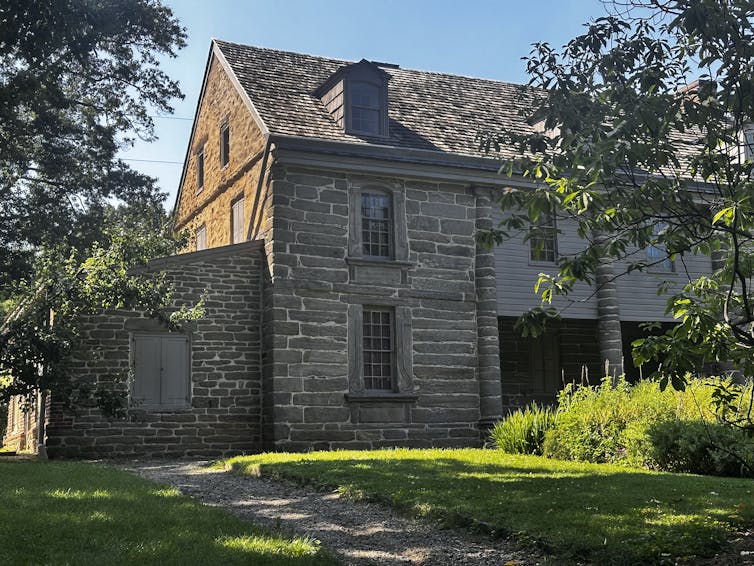
Magpieturtle/Wikimedia Commons, CC BY
A 200-year-old nest
Rat nests are common in historic structures, particularly homes like Bartram’s that contained kitchens and buildings that were used for food storage, such as cellars.
Bartram collected plants from around eastern North America along with those sent to him by naturalists in Europe. His sons, John Jr. and William, and later his granddaughter Ann Bartram Carr, continued to expand the garden, which gained international fame during the 18th and 19th centuries.
The rat nest was discovered during historic preservation work at the Bartram home in 1977. My analysis of the materials in the nest indicates that it was formed in the late 18th and early 19th century. The materials are representative of the plants rodents would have been foraging from the Bartram home and garden.
The plants I identified weren’t restricted to those sold by the Bartram family as a part of their nursery business. Nor were they limited to plants that were traded between naturalists hoping to learn more about the flora of the American Colonies. They included crops such as wheat, buckwheat, corn, parsnips and beans grown by the family to feed themselves; herbs such as lemongrass, basil and mint used for medicine by the family; and many wild and weedy plants – for example, brambles, corn cockle, and broom and needle grasses – that were not intentionally grown by the Bartrams but were nonetheless collected by the rats on the property.
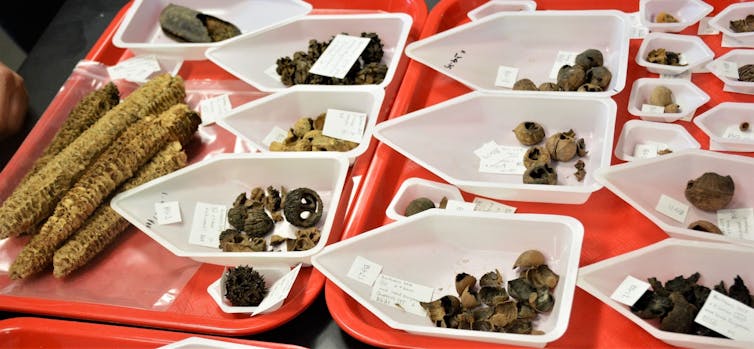
Alexandria Mitchem Hansen, CC BY-NC-SA
By studying the plants foraged by these rats, I learned not only about the important scientific and commercial plants in the garden, but also about the food and medicine the family were eating and using, including imported snacks such as peanuts and Brazil nuts, which were not grown in the garden but could have been purchased in Philadelphia.
Sorting 11 pounds of material
I am an archaeobotanist, which means I recover and identify plants from the past.
Over the course of almost three years, I sorted through over 11 pounds (5 kilograms) of material from the rat nest recovered from the Bartrams’ home and stored at the Center for the Analysis of Archaeological Materials at the Penn Museum.
Because there is often a lot of material, archaeologists divide these kinds of samples using geological sieves, which are scientific screening tools that filter samples by size. This makes the material easier to sort.
Then I used a microscope to sort and identify the plants therein. Archaeobotanists find various parts of plants, including seeds, chaff, fruit pits, nutshells and cobs. The plants I identified ranged in size from whole corncobs to weed seeds smaller than half a millimeter.
To identify the species of plants, I used reference manuals, comparative collections of plant seeds and other parts, and help from the archaeobotanists at the Penn Museum. I also studied images from herbaria, which are collections of historic plants that have been preserved and archived.
In the future, I plan to focus on the weedy plants recovered from the rat nest. The majority of invasive species in the United States were originally introduced in horticultural contexts, including botanic gardens and nurseries. Data from Bartram’s Garden will help me and other scholars better understand the timing and details of this process.
Read more of our stories about Philadelphia, or sign up for our Philadelphia newsletter on Substack.

Alexandria Mitchem Hansen receives funding from the McNeil Center for Early American Studies, the American Philosophical Society, the Explorer's Club, the Society for Historical Archaeology, the Society for Ethnobiology, and Columbia University.