
Key cell traits help plants survive in saltwater
- R researchers have identified key cell traits that help plants survive in saltwater, which could lead to creating salt-tolerant crops.
- The study focused on mangrove trees, which have evolved to thrive in salty environments and found that they have unusually small cells and thicker cell walls.
- These adaptations provide the necessary mechanical strength to tolerate saltwater while preventing wilting, allowing mangroves to survive in saline coastal habitats.
- The research team analyzed 34 mangrove species and more than 30 closely related organisms across 17 plant families, revealing that smaller cells are a common trait among salt-tolerant plants.
- By manipulating cell size and cell wall properties, scientists may be able to engineer salt-tolerant crops, offering a promising solution to the challenges posed by rising sea levels and saltwater inundation.
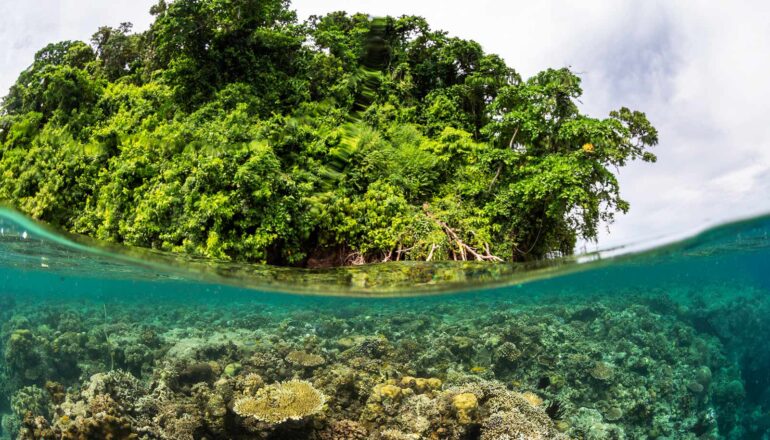
Researchers have found the cellular key to helping plants survive in saltwater.
Rising sea levels along coastlines not only threaten populations, but also pose a danger to agricultural crops, which may be damaged by surging amounts of saltwater. Researchers have, in response, sought to improve salt-tolerance in plants.
In the new paper, scientists report the identification of cell traits that are critical to tolerating saltwater inundation. The finding potentially offers new pathways for creating plants that can survive in harsh environments.
The research, which appears in the journal Current Biology, focuses on mangrove trees—plants that grow along tropical and subtropical coastal areas where saltwater is abundant.
“This work reveals that just a few simple cell traits are critical to tolerating the extreme conditions experienced by some of the most distinctive and resilient plants in the world,” says Adam Roddy, an assistant professor in New York University’s environmental studies department and one of the paper’s authors.
The ability of mangroves—which have evolved nearly 30 times over the last roughly 200 million years—to survive in saltwater is well-known. But it’s been unclear what in mangroves’ cellular makeup explains their durability in these conditions.
To explore this matter, the research team, which also included scientists from Guangxi University, Florida International University, and San Francisco State University, analyzed 34 mangroves species and more than 30 closely related organisms across 17 plant families. The analysis, which also considered how these species have evolved over time, included both coastal and inland species.
The results showed that, compared to their inland relatives, mangroves have unusually small cells and thicker cell walls, which together provide the greater mechanical strength needed to tolerate saltwater while also preventing wilting. More specifically, species that are able to live in saline coastal habitats have repeatedly evolved smaller, stronger cells.
“Mangroves are known for exhibiting a variety of interesting and complex adaptations to saltwater inundation, such as excluding large amounts of salt from their tissues or even taking up salt but then secreting it,” explains coauthor Guo-Feng Jiang of Guanxi University.
“While each of these various adaptations is fascinating, studying the breadth of biodiversity often reveals that nature offers simple solutions to complex challenges.”
“These results also point to a promising strategy to engineering salt-tolerant plants: manipulating cell size and cell wall properties,” adds Roddy.
This research was supported by grants from the US National Science Foundation.
Source: NYU
The post Key cell traits help plants survive in saltwater appeared first on Futurity.