
Trump tariffs and warming India-China ties have silenced the Quad partnership … for now
- The Quad partnership between the US, India, Australia, and Japan has been on hold due to disagreements over trade tariffs and warming ties between India and China.
- The US imposed a 25% tariff on Indian goods in August 2025, which was followed by additional punitive duties on New Delhi’s purchases of Russian oil, straining relations with the US.
- India has been tilting towards China economically and geopolitically, with Prime Minister Narendra Modi visiting China during the Shanghai Cooperation Organization summit meeting in August and framing the two countries as development partners.
- The Trump administration’s growing embrace of India’s archrival Pakistan has also soured US-India ties, with the US inviting Pakistan’s army chief to the White House despite India’s anger over the move.
- Despite the current tensions, there is still guarded optimism that the Quad can recover if a mutually acceptable trade deal between India and the US can be reached, and New Delhi can craft an agenda for the Quad framework that is acceptable to the current US administration.
When leaders of “the Quad” last met in September 2024, host and then-President Joe Biden declared the partnership between the United States, India, Australia and Japan to be “more strategically aligned than ever before.”
“The Quad is here to stay,” trumpeted Indian Prime Minister Narendra Modi.
Fast-forward a little over a year, however, and the tune has changed.
Leaders of the Quad were due to hold their latest summit in November 2025, with India hosting. But the month came and went, and no event was held. A future date has yet to be announced.
Why the silence? As experts of international institutions and the geopolitics and geoeconomics of the Indo-Pacific, we believe the answers can be found in the calculus of the two largest members involved: India and the U.S.
For the Trump administration, the domestic dividends of the Quad are not immediately obvious. Meanwhile, New Delhi is more concerned about how to position itself amid the great power competition between China and the U.S.
The result is paralysis for the Quad, for now.
The evolution of the Quad
The Quadrilateral Security Dialogue, to give the Quad its full name, began life in 2004.
The Quad 1.0 focused on humanitarian disaster assistance and cooperation after the Indian Ocean tsunami. In 2007, under the vision of then-Japanese Prime Minister Shinzo Abe, the Quad was recast as a platform to promote a free and prosperous Indo-Pacific, with an eye toward maritime security and economic cooperation.
Since then, the Quad has seen many fits and starts. Australia withdrew from the partnership in 2008 when it prioritized trade relations with China. India, too, has at times been tepid about the Quad’s continuation, partly due to its legacy of nonalignment and concerns over managing relations with Beijing.
The Quad 2.0 came to life in 2017 as the four core members coalesced around a shared sentiment of countering China’s rising power.
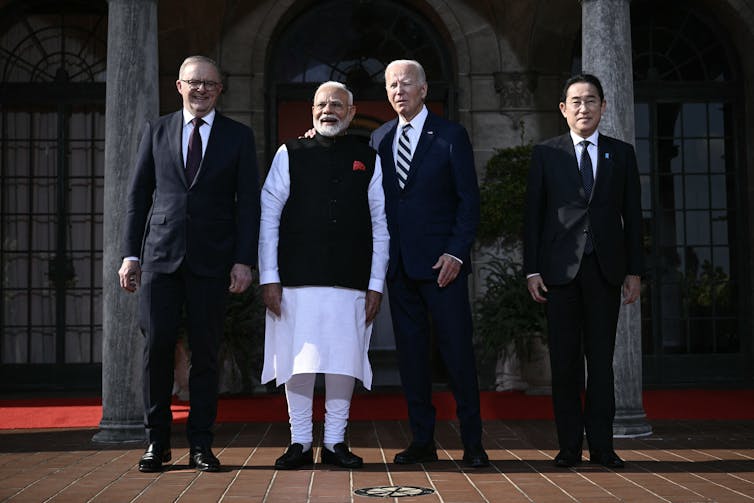
Brendan Smialowski/AFP via Getty Images
Despite its name, the Quadrilateral Security Dialogue has increasingly gravitated toward nonsecurity agendas, from global health to maritime domain awareness and critical technologies.
Yet even as this emerging Quad 3.0 has foregrounded cooperation around the slogan “development, stability and prosperity,” it is over trade and tariffs that the two largest members of the Quad are not seeing eye to eye.
The eagle and elephant tussle over tariffs
On Aug. 1, 2025, Washington imposed a 25% reciprocal tariff on Indian goods over long-standing trade frictions, notably over access to India’s agricultural market. It was followed by an additional 25% punitive duty for New Delhi’s continued purchases of Russian oil.
The combined 50% U.S. tariff was accompanied by another move that upset New Delhi: new U.S. restrictions on H-1B visas. Some 70% of all holders of the U.S. visas, designed for temporary skilled workers, are Indian nationals.
The rift between New Delhi and Washington widened with India’s decision to attend a meeting in Rio de Janeiro in September of the so-called BRICS nations. That was interpreted as an “anti-U.S.” summit by Washington given its composition of largely Global South nations and other countryies antagonistic to the West, including Russia and China.
As a key member of the BRICS grouping, India’s attendance should have come as no real surprise. Even so, and despite Modi’s decision not to attend personally, the U.S. took umbrage, with U.S. Secretary of Commerce Howard Lutnick criticizing India’s BRICS membership and accusing New Delhi of having “rubbed the United States the wrong way.”
Lutnick’s comments are indicative of the cooling ties between New Delhi and Washington. Since the end of the Cold War, India has been seen by Washington as a democratic ally and a vital U.S. partner in the Indo-Pacific. The two countries have shared strategic and defense partnerships – a foundational aspect of the Quad.
And despite recent tensions, the factors underpinning U.S.-India relations remain constant. The U.S. is India’s largest trading partner, with bilateral trade reaching US$131.84 billion in the 2024-25 fiscal year.
This gives New Delhi not only economic leverage over the U.S. but also a strategic rationale to continue its cooperation with Washington.
A countering ‘Dragon-Elephant’ tango?
Yet at the same time, India appears to be increasingly tilting toward China, both economically and in geopolitics.
Modi visited China during the Shanghai Cooperation Organization summit meeting in August and framed the two countries as development partners, not rivals. This has been interpreted as a rapprochement between China and India after decades of border skirmishes and maritime friction.
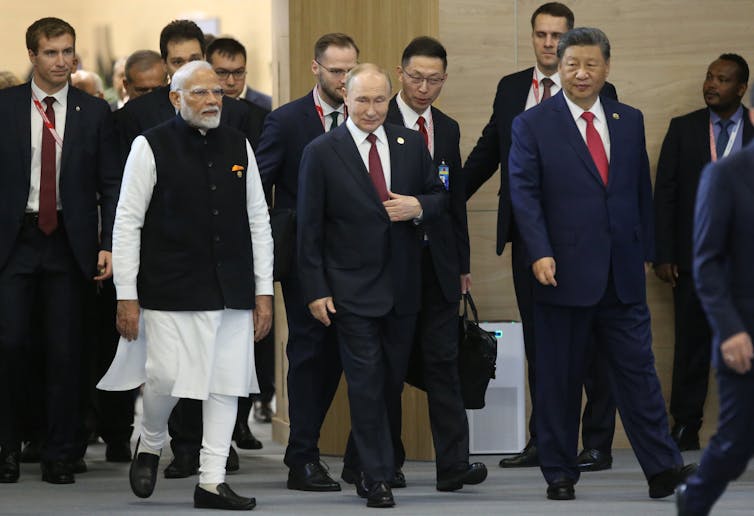
Contributor/Getty Images
Earlier this year, Chinese leader Xi Jinping used the term “Dragon-Elephant Tango” to promote a vision of India-China ties based on “mutual achievement.”
Despite the U.S. surpassing China as India’s biggest trading partner in 2021-22, investment ties between New Delhi and Beijing have grown steadily between 2005 and 2025, with only some intermittent friction.
However, what can appear as a tilt toward Beijing is better understood through structural roots in India’s economic realities as well as the country’s long-standing commitment to nonalignment.
The relationship between India and China is marked by significant economic interdependence rather than political convergence. India’s imports are largely coming from China, especially in the areas of machinery, electronics and other intermediate goods.
Yet for all of the convergence, areas of bilateral tensions remain. India’s growing trade deficit with China and Beijing’s ironclad relationship with Pakistan – along with unresolved border issues – limit how far New Delhi is willing to align with Beijing strategically.
Nevertheless, India-China relations are no doubt warming, especially in the wake of Trump’s tariffs. Indicative of that shift were India’s exports to China, which surged by 90% in November to $2.2 billion.
Broader sources of Indian-US tension
It isn’t just the warming China-India relationship that has thrown a wrench into the Quad’s works. The Trump administration’s growing embrace of India’s archrival Pakistan has also soured U.S.-India ties.
Trump’s claim to have mediated an end to the brief Pakistan-India war in May and his subsequent invitation of Pakistan’s army chief to the White House were met with anger in India.
That dispute was mirrored by the one over Russian oil, which had precipitated some of Trump’s tariffs on India. Modi’s government has walked a tightrope between the U.S. and Russia, wanting to keep open the possibility of good relations with Russian President Vladimir Putin, while managing tensions with the U.S. That’s why Putin’s visit to India in December held such symbolic value.
The Modi government stopped short of explicit long-term commitments to new Russian oil purchases and did not chart any new defense deals. In that, as with the issue over Washington’s embrace of Pakistan, India has sought to balance competing camps, creating space to maintain an open door with the U.S. without abandoning India’s strategic autonomy on what nations it does business with.
Optimism amid paralysis
So, how does all this diplomatic tangoing affect the Quad?
The result, it appears, is paralysis at this juncture. But it is important to point out that neither country wants to pronounce the Quad dead. The latest National Security Strategy of the United States explicitly mentions the Quad as part of efforts to “win the economic future” in Asia.
And both nations continue to reaffirm their commitment to the partnership – betting that political conditions will stabilize and that global trends may turn in their favor.
So there are still reasons for guarded optimism. Recent progress in trade negotiations and gradual reductions in Russian oil imports could ease Washington’s skepticism over India.
And for their part, Japan and Australia are trying to keep the momentum going – Japan with its naval and coast guard capabilities and Australia with infrastructure and health initiatives.
If a mutually acceptable trade deal with the U.S. can emerge, and New Delhi can craft an agenda for the Quad framework that is acceptable to the current U.S. administration, a leaders summit could still materialize in 2026.
But the louder the tariff wars between India and the U.S. become, the slimmer the chance for a stronger Quad in the near term.

Hyeran Jo receives funding from the Carnegie Corporation of New York (G-PS-24-62004, Small State Statecraft and Realignment). The statements made and views expressed are solely the responsibility of the author.
Yoon Jung Choi does not receive funding from any organization related to this article. The statements made and views expressed are solely the responsibility of the author.