Studying Physics in Microgravity
- Researchers conducted an experiment on the International Space Station to study physics in microgravity, which may advance fields like fire suppression and plant growth in space.
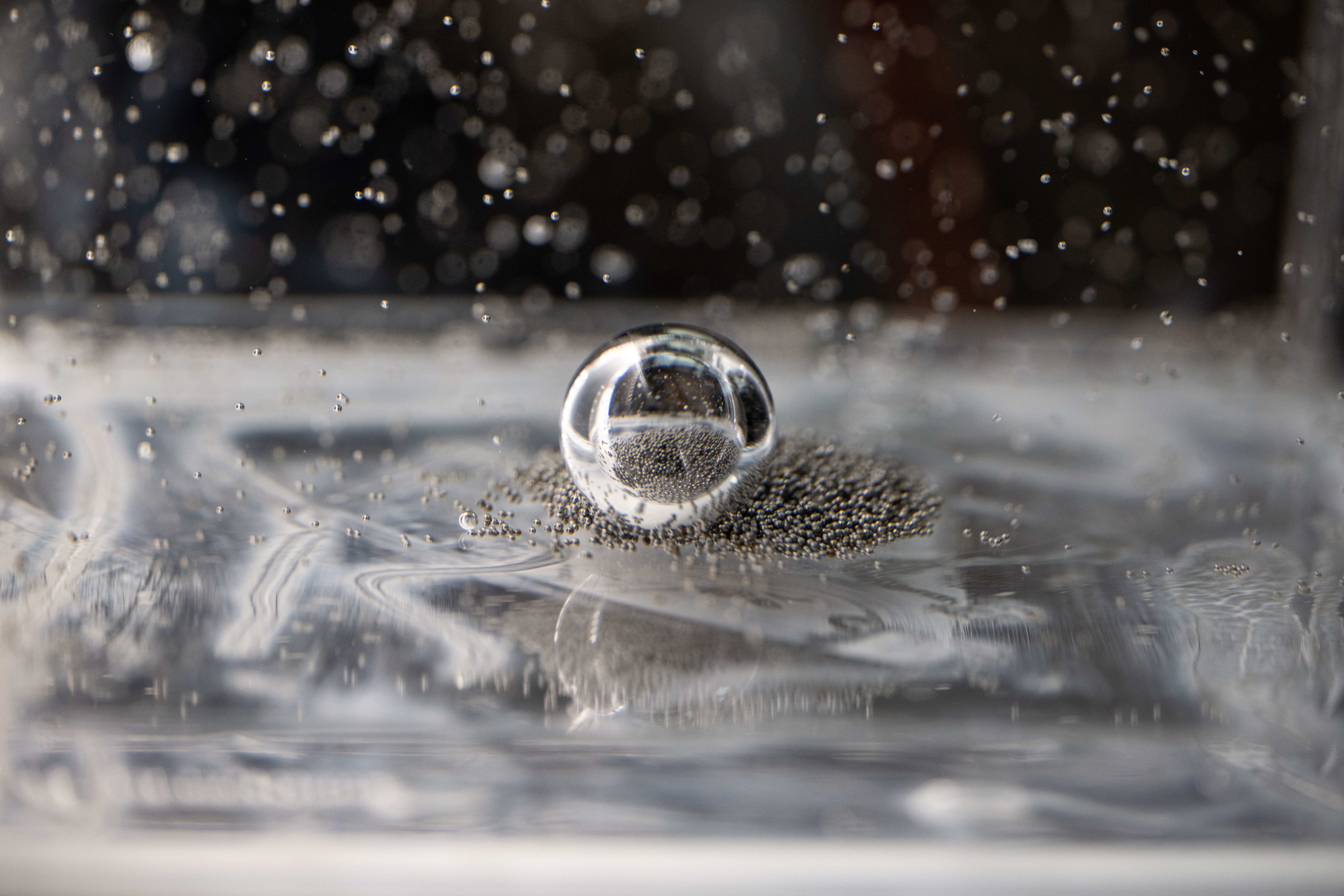
- The Fluid Particles experiment used oscillating frequencies to observe how particles cluster and form larger structures in microgravity, with potential applications for understanding phenomena on Earth such as pollen dispersion and algae blooms.
- Insights from the research could also inform long-duration missions like Artemis and future human expeditions to Mars, where understanding microgravity’s effects is crucial.
- The experiment used a bulk container filled with viscous fluid and embedded particles, which was subjected to oscillating frequencies in the Microgravity Science Glovebox aboard the space station.
- By studying physics in microgravity, scientists can gain a better understanding of how particles behave in unique environments, leading to breakthroughs in various fields and applications on both Earth and in space.
In this Oct. 20, 2025, photo, tiny ball bearings surround a larger central bearing during the Fluid Particles experiment, conducted inside the Microgravity Science Glovebox (MSG) aboard the International Space Station’s Destiny laboratory module. A bulk container installed in the MSG, filled with viscous fluid and embedded particles, is subjected to oscillating frequencies to observe how the particles cluster and form larger structures in microgravity. Insights from this research may advance fire suppression, lunar dust mitigation, and plant growth in space. On Earth, the findings could inform our understanding of pollen dispersion, algae blooms, plastic pollution, and sea salt transport during storms.
In addition to uncovering potential benefits on Earth, research done aboard the space station helps inform long-duration missions like Artemis and future human expeditions to Mars.
Image credit: NASA/Zena Cardman
link
Q. What is the purpose of the Fluid Particles experiment conducted inside the Microgravity Science Glovebox?
A. The experiment aims to observe how particles cluster and form larger structures in microgravity, which may advance fire suppression, lunar dust mitigation, and plant growth in space.
Q. Where was the Fluid Particles experiment conducted?
A. The experiment was conducted aboard the International Space Station’s Destiny laboratory module.
Q. What are some potential benefits of this research on Earth?
A. Insights from this research may inform our understanding of pollen dispersion, algae blooms, plastic pollution, and sea salt transport during storms.
Q. How does this research relate to long-duration missions like Artemis?
A. Research done aboard the space station helps inform long-duration missions like Artemis and future human expeditions to Mars.
Q. What is the Microgravity Science Glovebox (MSG)?
A. The MSG is a facility inside the International Space Station where experiments can be conducted in microgravity conditions.
Q. Who took this photo of the Fluid Particles experiment?
A. Zena Cardman, a NASA photographer, took this photo on October 20, 2025.
Q. What type of fluid was used in the experiment?
A. The experiment used a bulk container filled with viscous fluid.
Q. Why is studying physics in microgravity important?
A. Studying physics in microgravity can provide insights into various natural phenomena and help advance our understanding of the universe.
Q. How does this research contribute to future human expeditions to Mars?
A. Research done aboard the space station helps inform future human expeditions to Mars by providing valuable insights into long-duration missions.
Q. What is the potential application of this research in fire suppression?
A. The findings from this research may advance fire suppression by understanding how particles cluster and form larger structures in microgravity, which could lead to more effective fire-fighting strategies.