
What a bear attack in a remote valley in Nepal tells us about the problem of aging rural communities
- Dorje Dundul, a 71-year-old resident of Nubri, Nepal, has been attacked by brown bears three times over the past five years due to outmigration of younger people from his village.
- The trend of bear attacks in rural areas like Nubri is linked to demographic changes, including aging populations and declining fertility rates, which have led to a lack of household labor forces and increased vulnerability to wildlife threats.
- In Nepal, the Manaslu Conservation Area Project has prohibited lethal traps for wild animals, but alternative solutions such as solar-powered electric fencing have not been effective in deterring bears from encroaching on human settlements.
- The situation is not unique to Nepal; similar dynamics are observed in other Asian countries, including Japan, where bear attacks are on the rise due to rural depopulation and urbanization.
- Residents like Dorje are grappling with the consequences of outmigration, including increased risk of wildlife threats, and are exploring alternative solutions that balance human safety with conservation efforts, such as banding together to cull more hostile bears or using non-lethal deterrents.

Dorje Dundul recently had his foot gnawed by a brown bear – a member of the species Ursus thibetanus, to be precise.
It wasn’t his first such encounter. Recounting the first of three such violent experiences over the past five years, Dorje told our research team: “My wife came home one evening and reported that a bear had eaten a lot of corn from the maize field behind our house. So, we decided to shoo it away. While my wife was setting up camp, I went to see how much the bear had eaten. The bear was just sitting there; it attacked me.”
Dorje dropped to the ground, but the bear ripped open his shirt and tore at his shoulder. “I started shouting and the bear ran away. My wife came, thinking I was messing with her, but when she saw the wounds, she knew what had happened.”
Researchers Dolma Choekyi Lama, Tsering Tinley and I spoke with Dorje – a 71-year-old resident of Nubri, a Buddhist enclave in the Nepalese highlands – as part of a three-year study of aging and migration.
Now, you may be forgiven for asking what a bear attack on a septuagenarian has to do with demographic change in Nepal. The answer, however, is everything.
In recent years, people across Nepal have witnessed an increase in bear attacks, a phenomenon recorded in news reports and academic studies.
Inhabitants of Nubri are at the forefront of this trend – and one of the main reasons is outmigration. People, especially young people, are leaving for education and employment opportunities elsewhere. It is depleting household labor forces, so much so that over 75% of those who were born in the valley and are now ages 5 to 19 have left and now live outside of Nubri.
It means that many older people, like Dorje and his wife, Tsewang, are left alone in their homes. Two of their daughters live abroad and one is in the capital, Kathmandu. Their only son runs a trekking lodge in another village.
Scarcity of ‘scarebears’
Until recently, when the corn was ripening, parents dispatched young people to the fields to light bonfires and bang pots all night to ward off bears. The lack of young people acting as deterrents, alongside the abandonment of outlying fields, is tempting bears to forage closer to human residences.
Outmigration in Nubri and similar villages is due in large part to a lack of educational and employment opportunities. The problems caused by the removal of younger people have been exacerbated by two other factors driving a rapidly aging population: People are living longer due to improvements in health care and sanitation; and fertility has declined since the early 2000s, from more than six to less than three births per woman.
These demographic forces have been accelerating population aging for some time, as illustrated by the population pyramid constructed from our 2012 household surveys in Nubri and neighboring Tsum.
A not-so-big surprise, anymore
Nepal is not alone in this phenomenon; similar dynamics are at play elsewhere in Asia. The New York Times reported in November 2025 that bear attacks are on the rise in Japan, too, partly driven by demographic trends. Farms there used to serve as a buffer zone, shielding urban residents from ursine intruders. However, rural depopulation is allowing bears to encroach on more densely populated areas, bringing safety concerns in conflict with conservation efforts.
Dorje can attest to those concerns. When we met him in 2023 he showed us deep claw marks running down his shoulder and arm, and he vowed to refrain from chasing away bears at night.
So in October 2025, Dorje and Tsewang harvested a field before marauding bears could get to it and hauled the corn to their courtyard for safekeeping. The courtyard is surrounded by stone walls piled high with firewood – not a fail-safe barrier but at least a deterrent. They covered the corn with a plastic tarp, and for extra measure Dorje decided to sleep on the veranda.
He described what happened next:
“I woke to a noise that sounded like ‘sharak, sharak.’ I thought it must be a bear rummaging under the plastic. Before I could do anything, the bear came up the stairs. When I shouted, it got frightened, roared and yanked at my mattress. Suddenly my foot was being pulled and I felt pain.”
Dorje suffered deep lacerations to his foot. Trained in traditional Tibetan medicine, he staunched the bleeding using, ironically, a tonic that contained bear liver.
Yet his life was still in danger due to the risk of infection. It took three days and an enormous expense by village standards – equivalent to roughly US$2,000 – before they could charter a helicopter to Kathmandu for further medical attention.
And Dorje is not the only victim. An elderly woman from another village bumped into a bear during a nocturnal excursion to her outhouse. It left her with a horrific slash from forehead to chin – and her son scrambling to find funds for her evacuation and treatment.
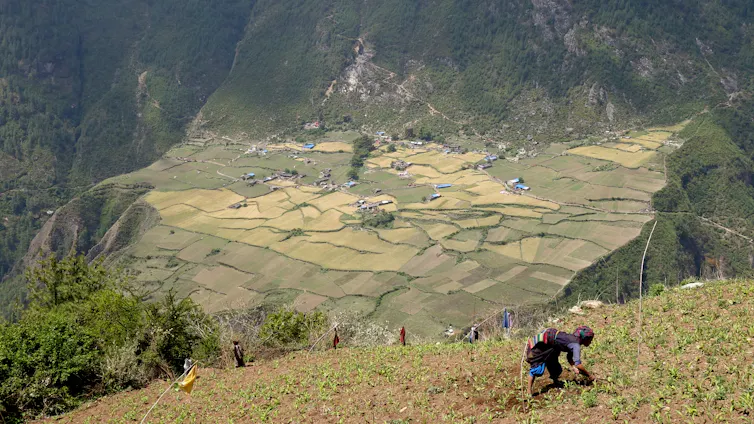
Geoff Childs, CC BY-SA
So how should Nepal’s highlanders respond to the increase in bear attacks?
Dorje explained that in the past they set lethal traps when bear encroachments became too dangerous. That option vanished with the creation of Manaslu Conservation Area Project, or MCAP, in the 1990s, a federal initiative to manage natural resources that strictly prohibits the killing of wild animals.
Learning to grin and bear it?
Dorje reasons that if MCAP temporarily relaxed the regulation, villagers could band together to cull the more hostile bears. He informed us that MCAP officials will hear nothing of that option, yet their solutions, such as solar-powered electric fencing, haven’t worked.
Dorje is reflective about the options he faces as young people leave the village, leaving older folk to battle the bears alone.
“At first, I felt that we should kill the bear. But the other side of my heart says, perhaps I did bad deeds in my past life, which is why the bear bit me. The bear came to eat corn, not to attack me. Killing it would just be another sinful act, creating a new cycle of cause and effect. So, why get angry about it?”
It remains to be seen how Nubri’s residents will respond to the mounting threats bears pose to their lives and livelihoods. But one thing is clear: For those who remain behind, the outmigration of younger residents is making the perils more imminent and the solutions more challenging.
Dolma Choekyi Lama and Tsering Tinley made significant contributions to this article. Both are research team members on the author’s project on population in an age of migration.

Geoff Childs receives funding from the National Science Foundation.