
Shrews shrink their brains and bodies to get through winter
- Two new studies have shed light on how shrews adapt to winter by shrinking their brains and bodies through a process called Dehnel’s phenomenon.
- The research, conducted by Stony Brook University researchers, reveals genetic and biological changes that occur in shrews during this process, including regulatory changes in oxidative phosphorylation and increased fatty acid metabolism.
- Scientists have found that the shrew’s genome plays a crucial role in its ability to shrink and regrow organs, with chromosomal rearrangements appearing to be integral to adaptive evolution and brain size plasticity.
- The findings may hold implications for understanding certain metabolic and neurological diseases, as well as how metabolism and brain health can work in humans, given that the same genes used by shrews are also present in humans.
- The research team’s discoveries could provide new insights into genetic plasticity and its role in evolution, with potential applications for improving our understanding of human health and disease.
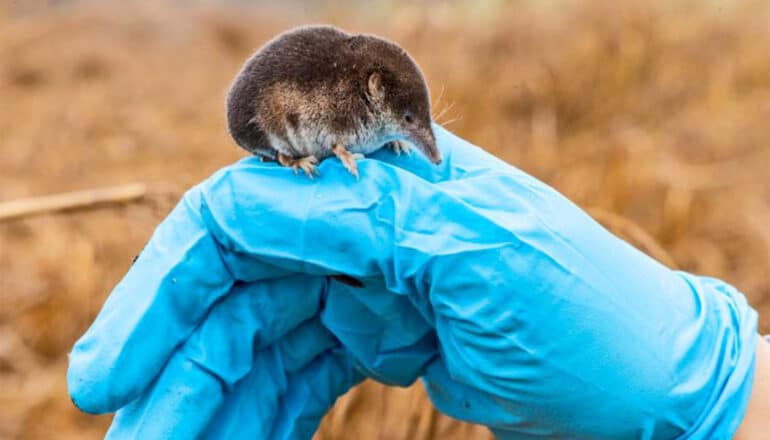
Two new studies further advance an understanding of how shrews adapt to the cold season by shrinking their brains and bodies.
Some mammals hibernate to survive in winter, but the Eurasian common shrew (Sorex araneus) employs Dehnel’s phenomenon to get through it. This is a metabolic process that enables shrews to conserve energy by shrinking their brain and other energy-consuming organs. In the spring, the organs grow back to normal size.
Scientists are learning more about how shrews can do this, and their findings may help us understand certain metabolic and neurological diseases.
Two newly published studies by a team of Stony Brook University researchers and their international collaborators uncover genetic and biological changes that occur in the shrew during Dehnel’s phenomenon. One paper in Genome ResearchxA0breaks down the dynamic metabolic and molecular changes during the shrew’s seasonal shrinking. The second paper in Molecular Biology and EvolutionxA0assesses genomic comparisons on the adaptive basis of brain size plasticity and chromosomal instability in the shrew.
“In mammals, Dehnel’s phenomenon is an extreme example of how the same genetic information can result in varying structures, we call that genetic plasticity. Together, these studies show that how the genome is arranged contributes to both the plasticity and evolution or genetic adaptation that enable this tiny shrew to continue being active through the winter, even as it gets colder and food grows scarcer,” says Liliana M. DxE1valos, professor in the ecology and evolution department at Stony Brook University, and the senior author on both papers.
In the Genome Research paper, the authors show that shrews display regulatory changes in oxidative phosphorylation and increased fatty acid metabolism during autumn into winter, which also occurs in hibernating animals. But the shrews also had an elevated winter expression of genes involved in gluconeogenesis, the biosynthesis of glucose from noncarbohydrate substrates.
The shrews also had an increase in FOXO signaling, part of a cell regulatory metabolic process in homeostasis. And the researchers conclude that with gluconeogenesis, the overexpression of FOXO is central and essential to the brain and organ shrinkage phenomenon.
Because the genomic contributions to seasonal brain size plasticity in shrews were unknown, the research team also coupled a chromosome-scale genome assembly with seasonal brain transcriptomes to discover relationships between molecular and genetic changes.
They found a few previously unknown gene expression changes that appear to be key mechanisms underlying Dehnel’s phenomenon. They also found that both positively selected and differentially expressed genes in the shrew hippocampus of the brain are overrepresented at open regions of the chromosomes that experience more breaks. This, the authors write, suggests in the shrew “that chromosomal rearrangements are integral to adaptive evolution and the regulation of brain size plasticity.”
“Before I had even heard of Dehnel’s phenomenon, I knew these shrews had an unusual number of rearrangements in their chromosomes that evolutionary biologists have studied for decades. Yet I did not expect the rearrangements themselves had something to do with the genes that adapt in this species to generate Dehnel’s phenomenon, to the genes that express more during the cycle of shrinking and regrowing, or to genes that may help repair breaks in the genome,” says William R. Thomas, lead author on both papers and a postdoctoral associate in the ecology and evolution department.
“This shows us how important the structure of the genome is to traits that make shrews unique. Plus, our findings are not confined to shrews,” he explains.
“The same genes shrews use are also present in humans. How the shrew’s energy management links to brain regrowth can help us figure out how metabolism and brain health can work in people as well.”
The research for both studies included collaborators from John Jay College of Criminal Justice, the Max Planck Institute of Animal Behavior, Aalborg University, and Universitat Autonoma de Barcelona.
Source: Stony Brook University
The post Shrews shrink their brains and bodies to get through winter appeared first on Futurity.