
Is the US heading for a government shutdown? 5 essential reads to occupy the mind while we wait to find out
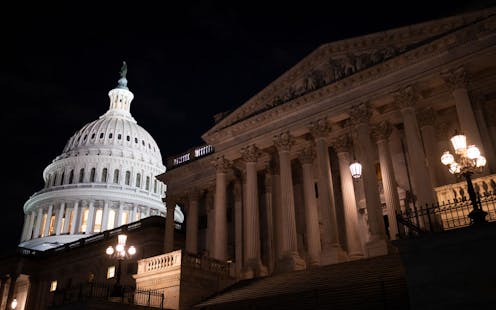
Brinkmanship, a political scramble to keep the lights on in Washington and finger-pointing over who is to the blame – we’ve been here before, right?
The threat of government shutdowns seems to be a regular feature of modern American politics.
And while this is not good for the nerves – or sleep patterns – of politicians, economists and a weary public, it does mean that The Conversation U.S. has a wealth of articles in the archive explaining what a shutdown is, why they happen and what the consequences are.
So while we watch the process play out in Washington, D.C. – at the time of writing, a spending bill was heading to the U.S. Senate after being passed by the House – we have gathered a few essential reads on the subject of shutdowns.
1. How a shutdown affects the economy
Should Congress fail to pass a spending bill by the end of March 14, 2025, the government will fall into a shutdown – and not for the first time. There have been about 21 government shutdowns in the U.S. Three of these took place during the first Trump administration, the longest starting three days before Christmas in 2018 and lasting 34 days.
But what is the economic cost of these shutdowns?
Northwestern finance scholar Scott R. Baker examined the short- and long-term effects of a shutdown in 2013.
Baker wrote that the most immediate impact of a shutdown is on the government’s day-to-day operations.
“Many national museums and parks are closed, immigration hearings are being postponed, and the Food and Drug Administration isn’t doing routine inspections of domestic food-processing facilities,” Baker wrote.
Whether a shutdown has a longer-term economic impact, Baker explained, depends on “how long the shutdown lasts and whether employees are paid their forgone wages after its conclusion.”
Read more:
How a government shutdown affects the economy
2. Who bears the brunt?
As a researcher who studies people’s wealth, Jay L. Zagorsky understands that the loss of a single paycheck can be devastating for many American families.
During the 2019 partial shutdown, about 800,000 federal workers were either furloughed or working without pay.
“Going without a paycheck for a few weeks is hard enough,” Zagorsky wrote. “If the shutdown lasts months or years, the situation could get very dire for the average government worker.”
Zagorsky noted that there is a bit of good news.
“Congress tends to give all affected workers back pay, regardless of whether they worked during the impasse,” he wrote.
Read more:
Federal workers begin to feel pain of shutdown as 800,000 lose their paychecks
3. Federal workers’ morale must be rock bottom
Of course, the current shutdown showdown comes as federal workers are already fretting over their job security thanks to President Donald Trump’s agenda of cutting down government.
A 2023 article by Susannah Bruns Ali, assistant professor of public policy and administration at Florida International University, explains how a shutdown might actually make it a little easier for the new administration to trim the federal workforce – but that might not be so great for the public.
“Shutdowns lead to more people being more likely to leave government employment – and higher workloads and lower motivation for those who remain,” Ali wrote. “These conditions may feed Republican political goals, but they harm the millions of Americans who depend on competent, timely assistance from the public servants on the government payroll. This ultimately leads to lower work performance and employee retention problems.”
4. The harm to the public
As Ali’s article alludes to, the harm of a shutdown is felt throughout the wider public. In a 2019 article, American University’s Morten Wendelbo expanded on one key area that’s affected: Americans’ health and safety.
Wendelbo explained that shutdowns make it harder for key U.S. agencies to respond to and prepare for disasters – due to the effects of a pause in funding, but also due to the impact shutdowns have on the retention and recruitment of public servants.
Writing on the impact of the then-ongoing 2019 shutdown, Wendelbo noted: “The shutdown weakens the government’s ability to foresee, prevent and respond to upcoming natural disasters. For example, hurricane modelers with NOAA, the agency chiefly responsible for storm forecasts, are furloughed.”
Read more:
The shutdown will harm the health and safety of Americans, even after it’s long over
5. So why do shutdowns happen?
Given the economic and societal risks of a government shutdown, why have they become a feature of modern politics?
In a 2023 interview, Northwestern University political scientist Laurel Harbridge-Yong explained: “Since the 1970s, both the House and Senate have become much more polarized. Members of the two parties are more unified internally and further apart from the opposing party. You don’t have the overlap between parties now that existed 50 years ago.”
In addition, electoral and congressional politics have shifted to increase the pressure on Republican lawmakers to appease a conservative base, “which has both individual and collective reasons to oppose a compromise.” Democrats, too, are less likely to compromise “both because they don’t want to gut programs that they put in place and also because they don’t want to make this look like a win for Republicans, who have been able to play chicken and get what they wanted,” Harbridge-Yong wrote.
This story is a roundup of articles from The Conversation’s archives and includes sections previously included in The Conversation articles.
