CubeSats’ Missions Begin
- CubeSats are small nanosatellites weighing 1-10 kilograms that use a standard size and form factor, designed for Earth observations and technology demonstrations.
- The development of CubeSats has advanced into its own industry, with collaboration between government, industry, and academia leading to increasing capabilities.
- CubeSats provide a cost-effective platform for science investigations, new technology demonstrations, and advanced mission concepts.
- A group of students from Mexico, Italy, Thailand, Malaysia, and Japan designed the CubeSats as part of a series of Earth observations and technology demonstrations.
- The deployment of CubeSats was successfully carried out by NASA astronaut Chris Williams using a small satellite orbital deployer into Earth orbit.
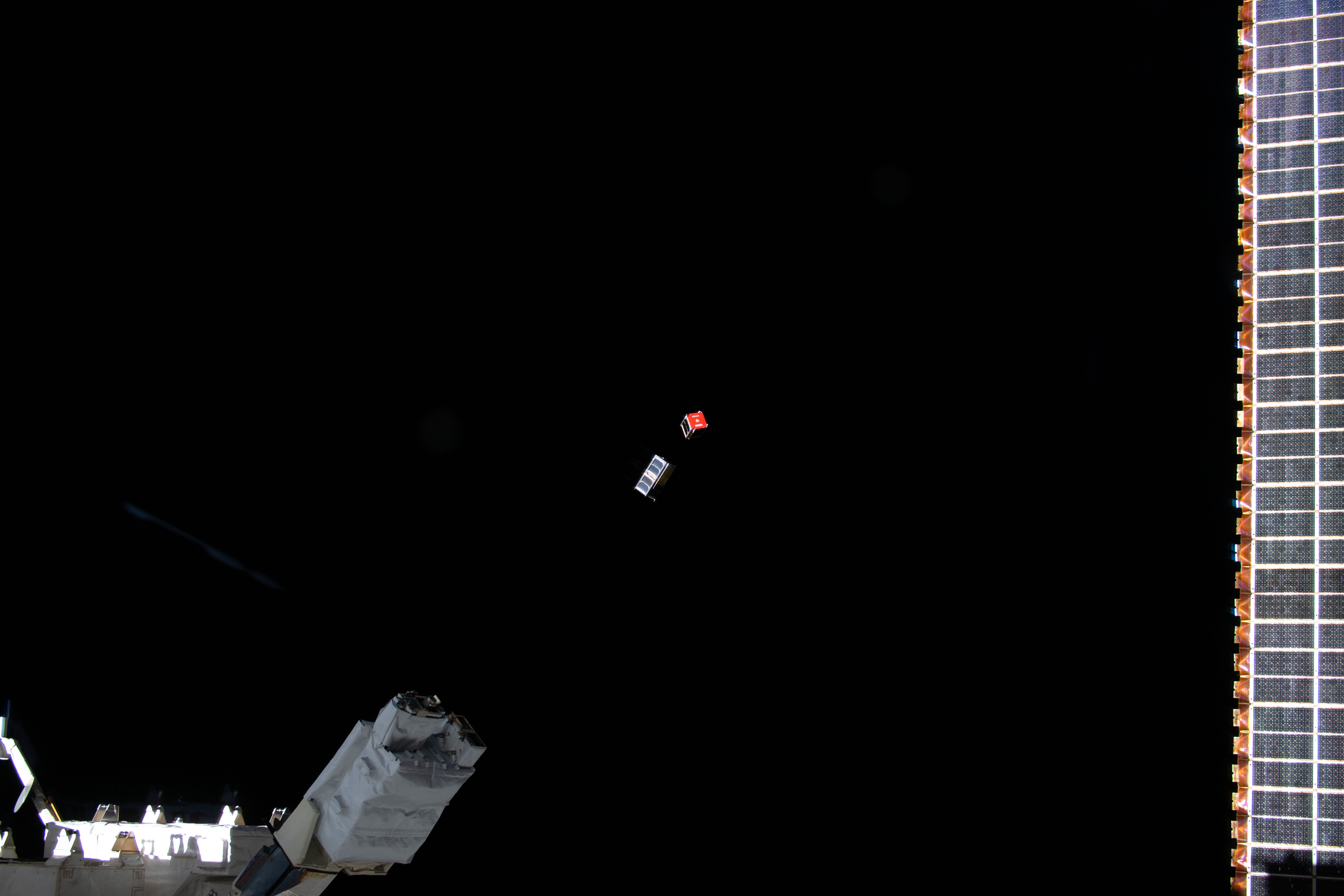
NASA astronaut Chris Williams pointed a camera out a window on the cupola as a set of CubeSats were deployed outside the Kibo laboratory module by a small satellite orbital deployer into Earth orbit. Students from Mexico, Italy, Thailand, Malaysia, and Japan designed the shoe-boxed satellites for a series of Earth observations and technology demonstrations.
CubeSats are a class of nanosatellites – small spacecraft weighing 1-10 kilograms – that use a standard size and form factor. The development of CubeSats has advanced into its own industry with government, industry and academia collaborating for ever increasing capabilities. CubeSats now provide a cost-effective platform for science investigations, new technology demonstrations and advanced mission concepts.
Image credit: NASA/Chris Williams
link
Q. What is a CubeSat?
A. A CubeSat is a class of nanosatellites that weigh between 1-10 kilograms and use a standard size and form factor.
Q. Who designed the CubeSats deployed in this mission?
A. Students from Mexico, Italy, Thailand, Malaysia, and Japan designed the shoe-boxed satellites for a series of Earth observations and technology demonstrations.
Q. What is the purpose of deploying CubeSats into Earth orbit?
A. The primary purpose of deploying CubeSats is to provide a cost-effective platform for science investigations, new technology demonstrations, and advanced mission concepts.
Q. How many kilograms do CubeSats typically weigh?
A. CubeSats typically weigh between 1-10 kilograms.
Q. What is the significance of the development of CubeSats?
A. The development of CubeSats has advanced into its own industry, with government, industry, and academia collaborating to increase capabilities.
Q. Who was involved in deploying the CubeSats?
A. NASA astronaut Chris Williams deployed the CubeSats using a small satellite orbital deployer.
Q. What is the standard size and form factor of CubeSats?
A. The standard size and form factor of CubeSats are used to define this class of nanosatellites.
Q. Why are CubeSats considered cost-effective?
A. CubeSats are considered cost-effective because they provide a low-cost platform for science investigations, new technology demonstrations, and advanced mission concepts.
Q. What is the purpose of the Kibo laboratory module in this deployment?
A. The Kibo laboratory module was used as a launch site to deploy the CubeSats into Earth orbit.
Q. Who collaborated on the development of the CubeSats?
A. Government, industry, and academia have all collaborated on the development of CubeSats to increase capabilities.