
Misunderstood hand signals may put cyclists in danger
- New research from Rice University suggests that misunderstandings around cyclist hand signals may put cyclists in danger.
- Cyclists are required by law to use hand signals, but drivers often rely on arm signals alone to understand a cyclist’s intentions, leading to misinterpretation and increased risk of accidents.
- Drivers’ visual processing of cyclists reveals that they focus on the rider’s back initially, then shift their attention to arm or head movements, highlighting the need for clearer communication cues.
- Distracted driving, even without taking eyes off the road, can significantly impair drivers’ ability to accurately predict a cyclist’s intentions, emphasizing the importance of staying attentive and focused while sharing the road.
- The study recommends that cyclists continue using formal hand signals written into law, but also calls for clearer, more intuitive ways to signal stopping or slowing, which are critical moments when misinterpretation can be especially dangerous.
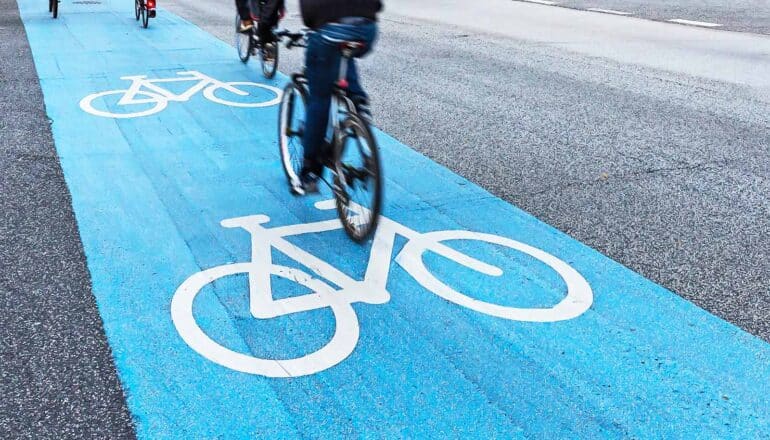
New research finds drivers and cyclists may not be communicating as effectively as they think.
As more Americans turn to biking for commuting, exercise, and recreation, the roads are growing more crowded and more dangerous as cyclist fatalities have risen sharply nationwide.
While crashes are often attributed to speeding, distracted driving, or inadequate infrastructure, the new research from Rice University suggests another factor may quietly increase risk.
“Confusion around cyclist hand signals could lead drivers to react too late or make a maneuver directly into a cyclist’s path,” says Christine Petersen, who led the research as a doctoral student in psychological sciences at Rice.
“Cyclists are required by law to use hand signals, but we don’t really know whether those signals consistently help drivers understand what a cyclist is about to do.”
That gap in understanding motivated Petersen’s work. While interactions between drivers and pedestrians have been studied extensively, cyclist-driver communication has received far less attention despite the growing number of people riding bikes on shared roads.
Petersen also examined how cyclist hand signals are defined in traffic laws across different countries, finding that while many nations rely on similar gestures, the rules—and expectations—are not universal.
“There’s very limited research focused specifically on cyclists,” Petersen says. “We’ve written rules into law, but we haven’t tested whether those rules align with how people actually think and react behind the wheel.”
To explore that disconnect, the study placed drivers in realistic driving scenarios and asked them to predict a cyclist’s next move—turning left, turning right, stopping or continuing straight—based on a combination of arm signals, head movement, and position on the road.
The results were clear. Drivers relied overwhelmingly on arm signals to judge a cyclist’s intentions. Other cues many people assume matter, such as where a cyclist is positioned in the lane or whether they glance over a shoulder, did not significantly improve accuracy.
Eye-tracking data revealed how drivers visually process cyclists in real time. Drivers initially focused on the cyclist’s back, keeping the rider fully in view. When a cyclist moved an arm or head, drivers’ attention shifted toward that movement, actively searching for communicative cues. Even so, drivers spent considerable time looking at a cyclist’s face, likely attempting to confirm intent through eye contact.
“Drivers aren’t ignoring cyclists,” Petersen says. “They’re trying to read them.”
But not all signals were equally effective. Straight-arm signals, pointing left to turn left or extending the right arm to turn right, were almost universally understood. In contrast, fewer than a quarter of drivers correctly interpreted the bent-arm right-turn signal that is still legally recognized in many places. Even the signal used to indicate stopping or slowing, while defined correctly by most drivers, was not the signal many says they would personally use if cycling.
“Signals that match the direction of movement, pointing where you’re going, are especially important for keeping interactions predictable and safe,” Petersen says. “Hand signals matter, but clarity matters even more.”
The study also examined what happens when drivers are cognitively distracted, even without taking their eyes off the road. When participants engaged in a simulated cellphone conversation, their ability to accurately predict cyclists’ intentions declined. Although arm signals remained the strongest predictor of accuracy, distraction reduced overall performance.
“Distraction isn’t just about looking away,” Petersen says. “Talking on a cellphone can slow reaction time and make it harder to process what a cyclist is trying to communicate.”
That risk is amplified by the fact that cyclists lack many of the visual cues drivers rely on with cars, such as brake lights and illuminated turn signals.
“Cyclists are already at a disadvantage,” Petersen says. “When a driver isn’t fully attentive, misunderstanding becomes more likely.”
For now, Petersen says the safest approach for cyclists is still to use the formal hand signals written into law, even if some are imperfect.
“They’re the shared language we currently have on the road,” she says.
At the same time, the findings raise broader questions about whether long-standing traffic laws fully reflect how people process information in fast-moving, real-world situations.
“Just because something was written into law years ago doesn’t mean it can’t be improved,” Petersen says. “Research gives us an opportunity to rethink communication and invest in better education, so drivers and cyclists understand each other.”
The study focused on a limited group of drivers, pointing to the need for future research that considers how culture, driving experience and cycling habits shape understanding. It also highlights the need for clearer, more intuitive ways to signal stopping or slowing—moments when misinterpretation can be especially dangerous.
As cycling continues to grow nationwide, Petersen says she hopes the research encourages a deeper conversation about predictability and shared responsibility on the road.
“When communication breaks down,” she says, “the risks increase for everyone.”
The research appears in Accident Analysis & Prevention.
Source: Rice University
The post Misunderstood hand signals may put cyclists in danger appeared first on Futurity.