
Philadelphia was once a sweet spot for chocolatiers and other candymakers who made iconic treats for Valentine’s Day and other holidays
- Philadelphia was once a hub for chocolatiers and candymakers who created iconic treats like Peeps, Reese’s Peanut Butter Cups, and Whitman’s Sampler chocolates.
- The city’s strategic location on the Delaware River made it an ideal place for sugar and candy ingredients to be transported, leading to a surge in candymakers and confectioners in the late 19th and early 20th centuries.
- Companies like Wilbur’s Chocolate (founded by Henry Oscar Wilbur and Samuel Croft) and Wunderle Candy Company (which employed Milton Hershey) emerged during this period, producing famous candies like Buds and candy corn.
- The city’s candy industry continued to grow in the 1920s and 1930s, with companies like H.B. Reese’s Peanut Butter Cups and Goldenberg Candy Company producing popular treats that are still enjoyed today.
- Although many of these candy companies have since moved out of Philadelphia, vestiges of the city’s candy dominance can still be found in unique shops like Shane’s Confectionery, which is arguably the oldest continuously operated candy shop in America.
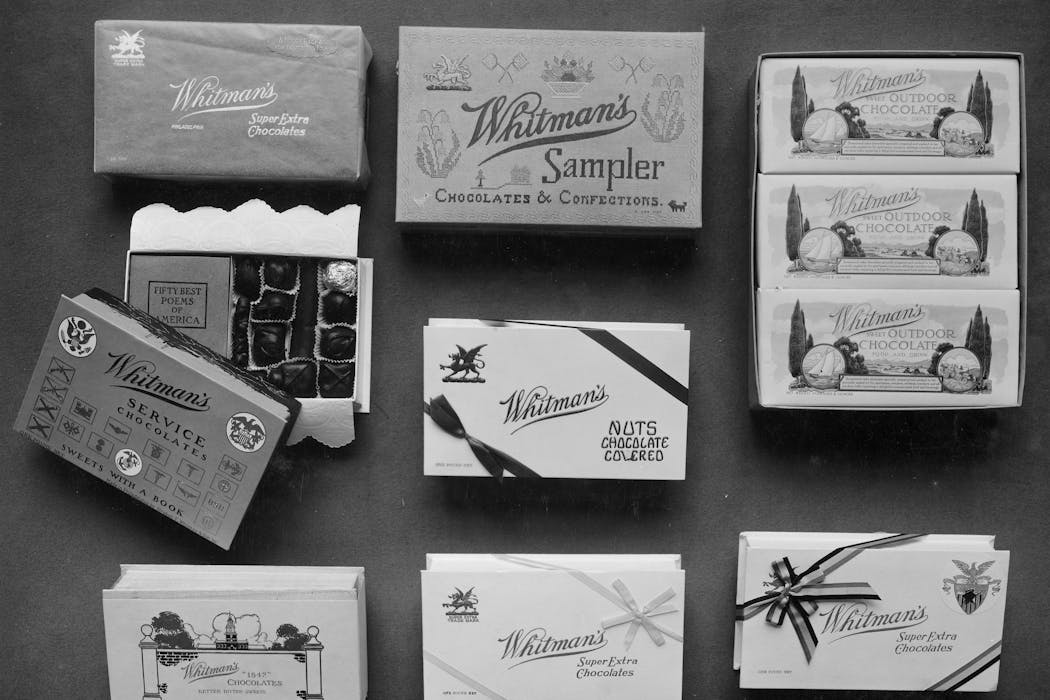
Many of America’s iconic holiday candies have Philadelphia or Pennsylvania roots – like Peeps on Easter, Reese’s peanut butter cups on Halloween, and a good, old-fashioned Whitman’s Sampler box of chocolates on Valentine’s Day.
As a Philadelphian and a cultural historian who teaches students about the history of American corporations, the role of the city in the nation’s food history often comes up in my class.
Philadelphia was one of the largest port cities in the U.S. through the early 20th century. Sugar and other candy ingredients were readily available from Delaware River docks. Improvements to sugar refining made the product significantly cheaper during the first half of the 19th century, while the Second Industrial Revolution, in the late 1800s and early 1900s, expanded transportation and trade.
This led to a dramatic increase in candymakers and confectioners in Philadelphia. Many, like Whitman’s Chocolates, one of the oldest still in existence, were concentrated in the Old City neighborhood.
Old City was also home to the oldest candy distributor in the country. Casani Candy Company was founded in 1865. While the company now operates across the Delaware River in Pennsauken, New Jersey, it continues to distribute hundreds of products, including Asher’s candy, which was founded in Philadelphia in 1892.
A box of chocolates
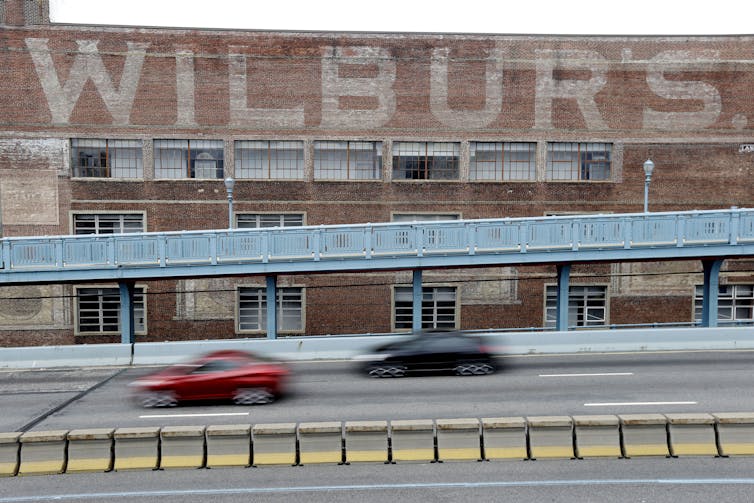
The company that would become Wilbur’s Chocolate was founded in 1865 by Henry Oscar Wilbur and Samuel Croft. After several moves, and a split between the founders in 1884, Wilbur opened a new facility in 1887 at the corner of Third and New streets, where the Chocolate Works condominiums are located today.
There, they began production of their famous Buds, made by pouring hot liquefied chocolate into molds that resembled flower buds.
Phillip Wunderle, maker of gumdrops and other candies, set up shop in North Liberties, just north of Old City, in 1871. An employee of Wunderle Candy Company named George Renninger is often credited with the invention of candy corn, the iconic Halloween staple. However, it would be a decade before this sugary treat, also called “chicken feed,” became popular.
Wunderle also employed a salesman who would go on to become a candy legend: Milton Hershey.
In 1900, Hershey revolutionized the chocolate industry by introducing the Hershey Bar, the first mass-produced milk chocolate in the United States. Seven years later, the Hershey Company introduced a bite-sized, teardrop-shaped chocolate similar to Wilbur’s buds. Legend has it that the name, Hershey’s Kisses, originated from the sound of the machine that manufactured the candies, but there were several other candies with the name that predate Hershey’s.
As Hershey grew more successful, Whitman’s looked for a way to maintain its market share. Whitman’s advertised heavily after the Civil War, and by the end of the 19th century, promoted its products with suggestive ads that linked chocolate with romance.

In 1912, Whitman’s introduced its Sampler box. It became a Valentine’s Day staple, especially after it became available in a heart-shaped box – a marketing stunt that English chocolate brand Cadbury reportedly started in 1868.
Jason Mowry/Getty Images
Chewing gum and movie snacks
The candy market in Philly – and nearby Hershey, Pennsylvania – continued to grow during the Roaring ‘20s.
A former dairy manager at Hershey named H.B. Reese built his own candy factory in Hershey in 1926, and two years later, he introduced his famous Peanut Butter Cups. Reese’s merged with Hershey’s in 1963 and later introduced their popular candy in different holiday shapes, like Easter eggs, Christmas trees and Valentine’s Day hearts.
Another company now owned by Hershey is York Peppermint Pattie, a chocolate-covered soft mint candy introduced in 1940 in a town 40 miles south of Hershey.
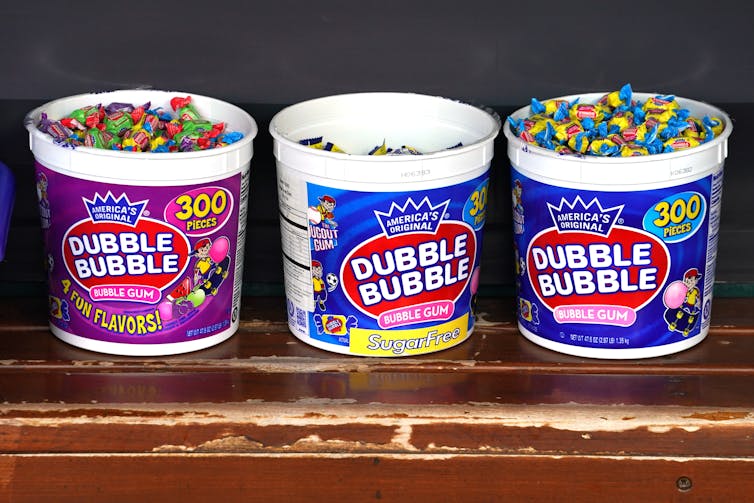
Back in Philadelphia, Frank H. Fleer, an inventor of Chiclets, the peppermint- flavored candy-coated gum, founded his confectionery company in 1885 in the Fairmount neighborhood. Fleer sold the invention to the Trenton, New Jersey-based American Chicle Company in 1914. In 1923, Fleer Corporation first included sports cards with its candy, and in 1928, company accountant Walter Diemer helped perfect the formula for Dubble Bubble, the first bubble gum.
AP Photo/Matt Rourke)
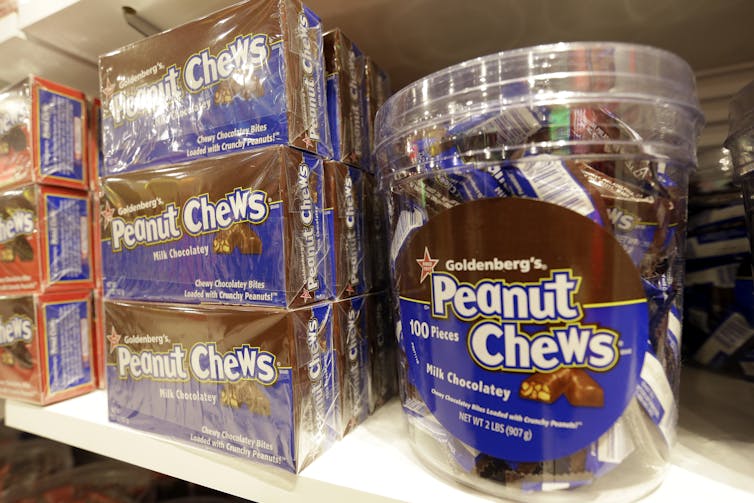
Meanwhile, Goldenberg Candy Company, which was founded in Philadelphia in 1890, introduced their Peanut Chews in 1917 as an energy source for troops during World War I. Goldenberg’s Peanut Chews are now owned by Just Born, which makes the popular Easter candy Peeps and has its headquarters in Bethlehem, Pennsylvania. However, Peanut Chews are produced out of a facility in the Holmesburg section of Northeast Philadelphia.
Further establishing southeast Pennsylvania as the chocolate capital of America was the emergence of Philadelphia-based Blumenthal Brothers Chocolate Company in 1909. Beginning in the mid-1920s, it began producing candy for movie concessions after being approached by Philadelphia concessions entrepreneur Jacob Beresin when some theaters placed a ban on popcorn in the 1920s, which was considered too messy. Blumenthal’s Goobers, Raisinets and Sno-Caps are still popular movie snacks, and a sweet complement to date night.
The post-World War II era brought a number of business and market changes that led many of these candy companies to move out of Philadelphia.
Yet vestiges of Philadelphia’s candy dominance can still be found around the city. For unique handmade candy this Valentine’s Day, Philly residents can visit Shane’s Confectionery, which is arguably the oldest, continuously operated candy shop in America. (There’s some debate to that claim because the space has been a candy shop since 1863, but Shane’s didn’t open until 1910.) And stop back in March to pick up some “Irish Potatoes” – coconut cream rolled in cinnamon – for St. Patrick’s Day.
AP Photo/Matt Rourke
Read more of our stories about Philadelphia and Pennsylvania, or sign up for our Philadelphia newsletter on Substack.

Jared Bahir Browsh does not work for, consult, own shares in or receive funding from any company or organization that would benefit from this article, and has disclosed no relevant affiliations beyond their academic appointment.