
Germany’s plan to deport Syrian refugees echoes 1980s effort to repatriate Turkish guest workers
- Germany’s plan to deport Syrian refugees has been compared to its 1980s effort to repatriate Turkish guest workers, echoing a similar policy implemented by Chancellor Helmut Kohl’s centrist Christian Democratic Union (CDU) party.
- The current proposal involves offering financial incentives of up to $4,650 per family to persuade Syrians to voluntarily return to their home country, Syria, which has been ravaged by war and faces significant humanitarian challenges.
- However, critics argue that the financial incentives are insufficient to restart one’s life in Syria, and many Syrians face dire hardships, including poverty, lack of electricity, water, sanitation, and medical supplies, making it difficult for them to reintegrate into their home country.
- The Turkish case from the 1980s provides a similar example of how voluntary returns can be problematic, with returnees facing financial and social hardship in Turkey, and many being ostracized as “Germanized Turks” upon their return.
- Germany’s decision to deport Syrians has been criticized for pandering to racism and Islamophobia that have been embedded in the country’s mainstream, and it remains to be seen whether the government will be able to persuade a significant number of Syrians to accept the financial incentives and leave the country voluntarily.
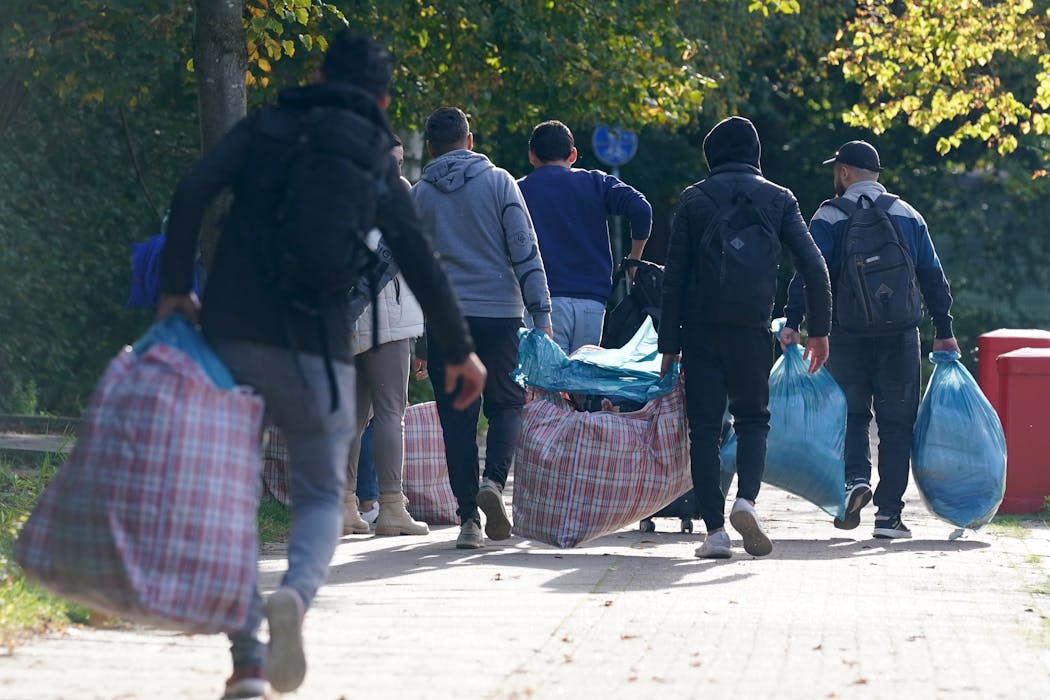
For 14 years while Syria’s brutal civil war raged, Germany provided a safe haven for those fleeing the violence. Now, a year after that conflict ended with the fall of the Assad regime in December 2024, many in Germany – including the country’s leader – want those same Syrians gone.
In November, German Chancellor Friedrich Merz announced a controversial plan to deport Syrian refugees “in the near future.” He also urged the 1 million Syrians in Germany, most of whom are Muslim, to voluntarily return.
This hardened stance toward Syrian refugees, expressed at the highest level of government, has been interpreted as Merz’s attempt to stave off Germany’s rising far-right party, the Alternative for Germany (AfD). In the February 2025 national election, the AfD won almost 21% of the vote, making it the second-largest party in the parliament. The government’s perceived rationale is that in getting tough on immigration, Merz will steal some of the thunder on an issue that has seen the AfD swell its support.
However, the reality is more complex. Racism and Islamophobia are not purely far-right phenomena. Rather, they have been part of mainstream German politics and society for decades.
As an expert in German migration history and far-right extremism, I have studied the history of racism and Islamophobia in Merz’s own party, the centrist Christian Democratic Union (CDU). My recent book explains how the CDU used similar tactics during the 1980s to kick out another group of predominantly Muslim migrants: Turks, who are Germany’s largest ethnic minority.
Paying Syrians to leave
Since Bashar Assad’s regime was toppled on Dec. 8, 2024, nearly 1.5 million externally displaced Syrians have voluntarily returned to their home country. That number comprises about one-quarter of all those who have fled since Syria’s civil war began in 2011.
However, Syrian refugees in Germany have been reluctant to return. Many have integrated into German society. About 15% have acquired German citizenship, and nearly half of working-age Syrians are employed in Germany. Some 250,000 Syrian children attend German schools.
Kay Nietfeld/picture alliance via Getty Images
The international legal principle of non-refoulement, which applies to German law, prohibits refugees from being forcibly returned to a country where they face serious threats to their life or freedom. As of December 2025, the United Nations Refugee Agency still stresses that refugees should not be forced to return to Syria.
Meanwhile, an official German program that facilitates the voluntary return of Syrians has been in effect since January 2025.
To persuade Syrians to leave, Germany is now offering to pay them. Since January, Syrian refugees in Germany have been able to apply online for up to US$4,650 (4,000 Euros) per family to assist their voluntary return. The financial incentives are facilitated through the German government’s official program.
Other European countries, along with the European Union and the U.N. Refugee Agency, are also offering Syrians financial incentives. A similar German policy applies to other migrant nationalities.
A destroyed homeland
Germany’s repatriation schemes have come under severe criticism from leading human rights organizations like Amnesty International and Human Rights Watch.
For starters, critics say, the money is far too meager to restart one’s life in Syria. Financial incentives can help with reintegration, but only if they are “robust and durable,” according to the Migration Policy Institute.
Moreover, two-thirds of people in Syria are dependent on humanitarian aid. Over 7 million remain internally displaced, and many Syrians do not have electricity, water, sanitation or medical supplies.
Many people’s homes there are destroyed or mired in land disputes.
Syrian human rights activists have also argued that the country remains unsafe for religious minorities, women and queer people.
Even German Foreign Minister Johann Wadephul softened his stance after a visit to Damascus on Oct. 30. “Here, hardly anyone can live a dignified life,” he said.
Turks in the 1980s: A similar policy
This is not the first time Germany has attempted to pay migrants to leave. In the 1980s, Merz’s party, the CDU, implemented a similar policy against Turkish migrants.
Millions of Turks came to West Germany in the 1960s and 1970s. The government formally recruited them as guest workers to help rebuild Germany after World War II.
By the late 1970s, they increasingly brought their spouses and children, becoming Germany’s largest ethnic minority.
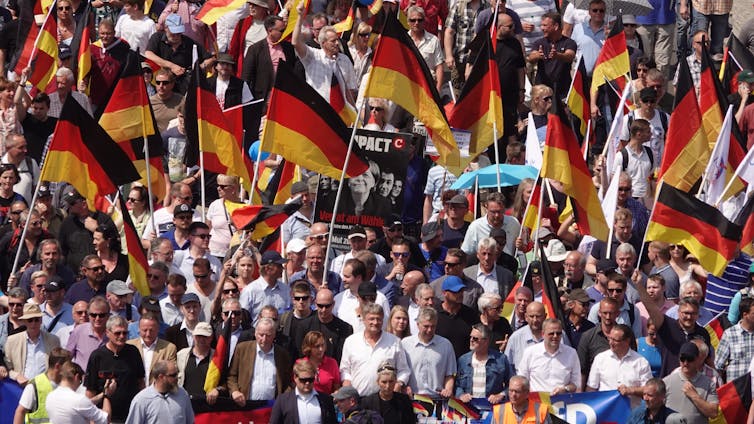
Meanwhile, racism and Islamophobia skyrocketed in 1980s Germany — both on the far right and in the center.
While neo-Nazis violently attacked Turks, Germans on all sides of the political spectrum argued that Islam was incompatible with Europe. It is a view that 40 years on is being echoed by politicians on the right both in Europe and in the Trump administration.

Henning Christoph/ullstein bild via Getty Images
Kicking out the Turks
In that racist climate, then-Chancellor Helmut Kohl, who led the centrist CDU from 1982 to 1998, expressed his desire to reduce the Turkish immigrant population by 50%.
But kicking out half of West Germany’s Turkish population was no easy feat — especially given the sensitivities that still plagued a country scarred by Nazi atrocities and the genocide of European Jews.
In the post-war years, West Germany was desperate to reestablish its reputation as a liberal democracy committed to human rights. As such, forced deportations were not an option.
Kohl’s solution, a precursor to Merz’s, was to pay Turks to leave. In 1983, West Germany passed the controversial remigration law, which offered Turks financial incentives to voluntarily return.
The 1983 law was widely criticized by rights activists as a “kicking out policy.”
Ultimately, 15% of Turkish migrants — approximately 250,000 men, women and children — took the money and left. It was one of the largest and fastest mass remigrations in modern European history.
However, returnees often faced financial and social hardship in Turkey. They struggled to reintegrate into the nation’s then-flailing economy. Many, especially children, were ostracized as “Germanized Turks.”
As the Turkish case shows, even a voluntary return is not always a happy homecoming.
Will Germany deport Syrians?
Germany today cannot realistically expect large numbers of Syrian refugees to accept the financial incentives. Amid the still ongoing humanitarian crisis in their home country, they would face far more dire hardships than Turks did in the 1980s.
In fact, only about 1,300 Syrians in Germany have voluntarily returned since Assad’s regime collapsed last year. That is just 0.1% of Germany’s Syrian population.
Merz has already announced that if Syrians refuse to leave, Germany will begin deporting some of them. He recently invited Syria’s president to Germany to discuss deporting Syrians with criminal records.
Other countries have already begun deportations of Syrian nationals, including Lebanon, Turkey and Jordan, the countries where most Syrian refugees are located.
Merz is, of course, responding to real political dynamics in Germany. The far right is indeed rising, which the center has responded to by moving further right. And as such, the fact that Merz’s party is cracking down on migration should not come as a surprise.
But today, as in the past, the response risks pandering to racism and Islamophobia that have been embedded in Germany’s mainstream. And Syrians, like Turks before them, are caught in the crossfire.

Michelle Lynn Kahn has received funding from the National Humanities Center, United States Holocaust Memorial Museum, American Historical Association, American Jewish Archives, and Alexander von Humboldt Foundation.