
Tennis is set for a ‘Battle of the Sexes’ sequel – with no movement behind it
- Tennis’ upcoming “Battle of the Sexes” event between Aryna Sabalenka and Nick Kyrgios has sparked controversy, with critics arguing that it may not be a meaningful representation of equality in sports.
- The event has been criticized for its modified rules, which include a smaller court size for Sabalenka and limited serves, potentially giving her an unfair advantage over Kyrgios.
- The event also raises questions about the relevance of women’s sports, with some arguing that it may be used to bolster arguments that the best woman cannot compete with the best man, even when rules are bent in her favor.
- The venue for the event, Dubai, has been criticized for its human rights record, including gender discrimination and restrictions on freedom of speech, which some see as an example of “sportswashing”.
- The event has been dismissed by critics as a publicity stunt and cash grab, with some arguing that it fails to deliver on its promise of reimagining what equality in sport can look like.
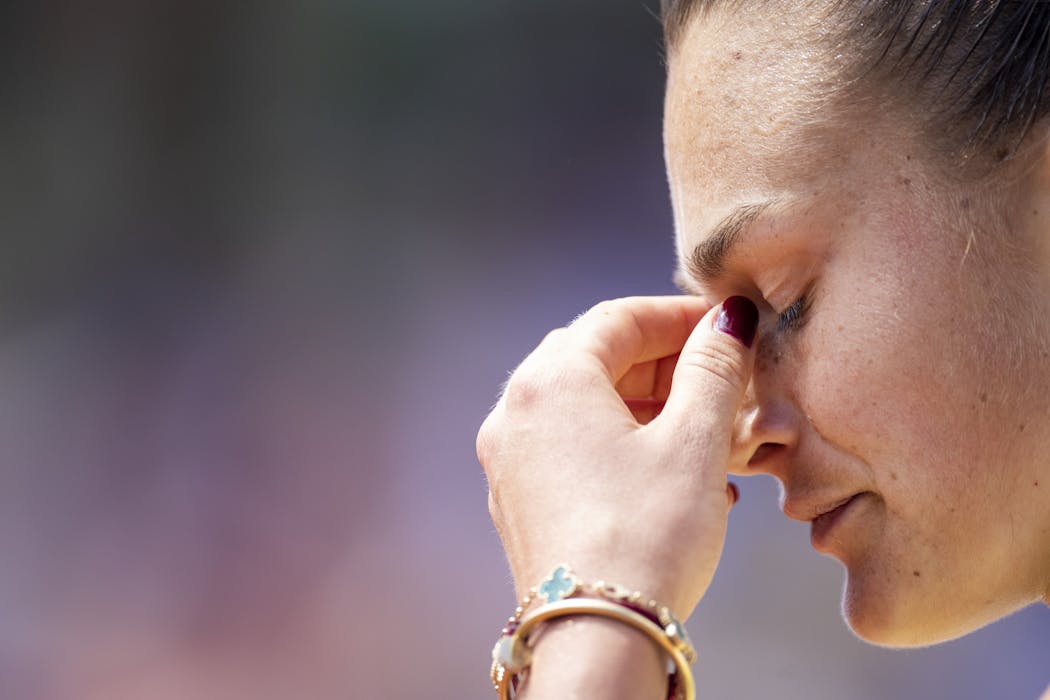
In an event billed as tennis’s latest “Battle of the Sexes,” Aryna Sabalenka, the No. 1-ranked women’s tennis player in the world, will take on Nick Kyrgios, who’s currently ranked No. 673 on the men’s tour, on Dec. 28, 2025, in Dubai.
“This is about respect, rivalry and reimagining what equality in sport can look like,” explained Stuart Duguid, who, along with tennis great Naomi Osaka, co-founded Evolve, the sports agency putting on the event.
“I’ll try my best to kick his ass,” Sabalenka said during a September 2025 press conference.
“She’s not going to beat me,” Kyrgios responded. “Do you really think I have to try 100%?”
Evolve has promoted the Dubai event as a sequel to the iconic 1973 “Battle of the Sexes,” in which Billie Jean King beat Bobby Riggs.
But as critical scholars of sport, we see important differences between the two contests. For one, there are the rules: different court dimensions, service restrictions and scoring systems. What’s more, the two events’ political and cultural contexts set them even further apart. While King’s victory is viewed as a feminist triumph over entrenched sexism, neither Sabalenka nor Kyrgios seem to be playing for anything beyond the court.
It makes us wonder whether women – and women’s sports more specifically – have anything to gain from this latest battle.
Putting ‘women’s lib’ on the map
The feminist movement of the early 1970s saw American women fight for better rights, opportunities, rewards, reproductive freedoms and bodily autonomy. They also sought access to and equality in sports. Women’s tennis led the way, as King and others bravely formed their own tour, unionized and negotiated for equal pay at the U.S. Open.
Riggs – a 55-year-old ex-champion and self-proclaimed “male chauvinist pig” – was a noisy antagonist. He maintained that better pay should go to men like him on the senior tour, not to women. To prove it – and to bully his way back into the limelight – Riggs pestered the 29-year-old King to play him.
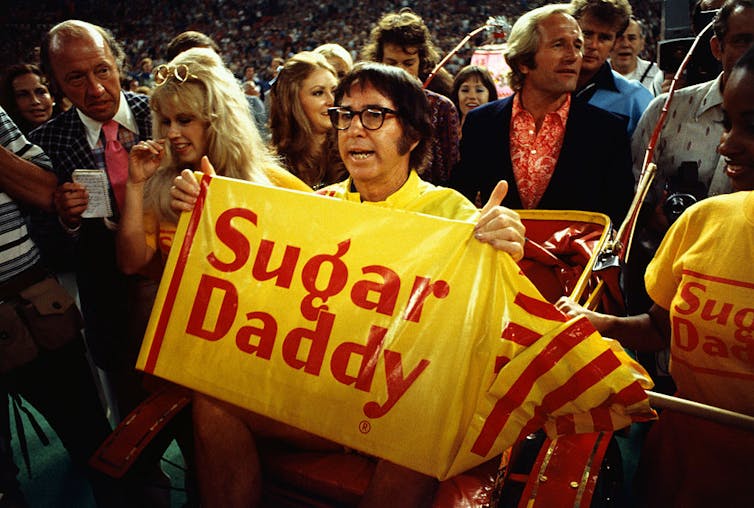
Bettmann/Getty Images
“You not only cannot beat a top male player,” he needled, “you can’t beat me, a tired old man.”
King refused.
“We didn’t need him; we were making it on our own merits,” she later explained
UPI/Bettmann Archive via Getty Images
But when Riggs trounced the No. 1 women’s player, Margaret Court, in May 1973, King, then ranked No. 2, felt she had no choice.
“Marge blew it,” she told reporters. “I’m going to put women’s lib where it should be.”
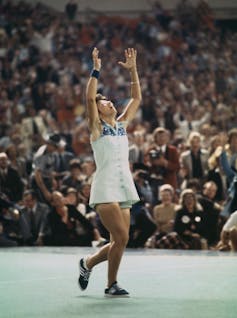
King rose to the occasion. Before 30,000 spectators at the Houston Astrodome and another 90 million television viewers, she walloped Riggs in three straight sets. Her victory took on an even larger significance, becoming a symbol of what women can accomplish when given the chance.
“It wasn’t about tennis,” King later assessed. “It was about social change.”
The apolitical star vs. the ‘bad boy’
So what, then, is the new “battle” about?
King has yet to comment on the 2025 event, but she is a fan of Sabalenka’s game.
“What I love about you is that when you come out to play, you bring all of yourself,” King told the four-time Grand Slam champion after her 2024 U.S. Open victory.
Off the court, however, the two women seem to have little in common.
King has always maintained that sports are political; Sabalenka has distanced herself from that position. When asked about Russia’s war in Ukraine, for example, the Belarusian explained, “I don’t want sport to be involved in politics, because I’m just a 25-year-old tennis player.”
King never argued that women were better players than the men. But “from a show-biz standpoint,” she clarified in her 1974 autobiography, “I felt we put on as good a performance as the men – sometimes better – and that that’s what people paid to see.”
Sabalenka, in contrast, once told a reporter that she prefers watching men’s tennis because “it’s more interesting” than the women’s game.
Comments like Sabalenka’s throw sand into the gears of the ongoing struggle for gender equity, to which King remains committed. Although all four Grand Slam events now offer equal prize money, disparities persist at lower-level tournaments.
At the 2024 Italian Open, for instance, men competed for a prize pool of US$8.5 million. The women’s equivalent was $5.5 million. That same year, women’s prize money at the Canadian Open totaled $2.5 million, while the men split $5.9 million. Men still receive better scheduling and court assignments, more media coverage and more lucrative sponsorships. As former No-2-ranked women’s tennis player Ons Jabeur put it, it’s not “just a question of money, but also respect.”
Meanwhile, Kyrgios, like Riggs more than half a century ago, has spoken out against equal pay for women players.
In fact, some might say Kyrgios’ sexism makes Riggs’ seem almost quaint. In 2015, he was fined $10,000 after making vulgar comments about his opponent’s girlfriend during a match. In 2021, he pleaded guilty to assaulting his ex-girlfriend after pushing her during an argument.
Kyrgios has “gone to all lengths” to distance himself from overtly misogynist influencers Andrew and Tristan Tate, who have been criminally charged with human trafficking, rape and assault. But this was only after Kyrgios faced significant backlash for expressing “low-key” love for the brothers and reposting Andrew on social platform X for “speaking facts as usual.”
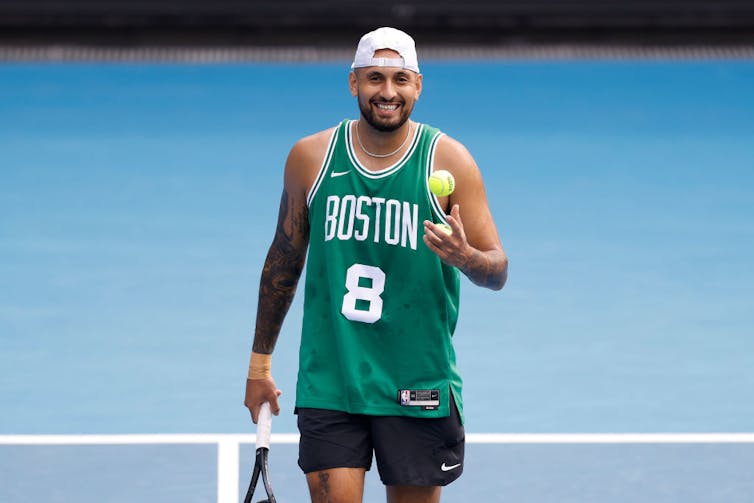
Daniel Pockett/Getty Images
Kyrgios – again, like Riggs – is also struggling to remain relevant.
By all accounts, he is a tremendously talented player who has yet to live up to his potential. Plagued with wrist and knee injuries, Kyrgios has competed in only six tour-level matches in the past three years: winning one, losing four and retiring in another. Consequently, the 2022 Wimbledon finalist, once ranked in the top 20, is better known as a “bad boy of tennis” who smashes rackets, makes lewd comments and gestures, tanks matches and verbally abuses umpires.
A lose-lose for women’s sports?
Kyrgios’ showdown with Sabalenka may be entertaining. But for women’s sports, it seems like a lose-lose.
If Sabalenka wins, critics will likely claim it’s because she had every advantage. Evolve has modified the rules to make her side of the court 9% smaller than Kyrgios’ in both length and width. The dimensions are based on Evolve’s calculation that the top women players move 9% slower than their male counterparts, although there is no published data to support the claim.
To further mitigate Kyrgios’ reported “power and speed advantage,” both players will be limited to just one serve. Unlike King and Riggs’ best-of-five sets, Sabalenka and Kyrgios will play best-of-three. Split sets between the two competitors will result in a 10-point tiebreaker.
A Kyrgios victory will only bolster arguments that the best woman cannot compete with the 673rd-ranked man, even when the rules are bent to her favor. We could see those arguments being weaponized against women’s sports more generally, which remain underresourced and undervalued.
There’s also the question of the venue.
The 2025 event will take place in the United Arab Emirates. The UAE government has been accused of egregious human rights abuses, which include gender discrimination, the criminalization of same-sex relations, and clamping down on freedom of speech and the media. Hosting high-profile sporting events distracts from these issues while cleansing the UAE’s public image in what’s known as “sportswashing.”
What does it mean to host a tennis “Battle of the Sexes” in a country where women are battling for basic human rights?
The 2017 Hollywood film “Battle of the Sexes” reaffirmed the importance of the King-Riggs contest.
Barring some surprise twist, no one will make a movie about the Sabalenka-Kyrgios duel in Dubai. We see it as nothing more than a publicity stunt and cash grab for Sabalenka, Kyrgios and, above all, Evolve. If this is “reimagining what equality in sport can look like,” as the organizers claim, then it is equality without substance.
And that is no battle at all.

The authors do not work for, consult, own shares in or receive funding from any company or organization that would benefit from this article, and have disclosed no relevant affiliations beyond their academic appointment.