
Building ‘beloved community’: Remembering the friendship between Martin Luther King Jr. and Buddhist monk Thich Nhat Hanh
- Thich Nhat Hanh, a Vietnamese Zen Buddhist monk, was inspired by Martin Luther King Jr.’s vision of “beloved community” and continued his work after King’s assassination.
- Hanh founded the School of Youth for Social Services in Vietnam to practice engaged Buddhism and help those affected by war, and later established the Plum Village monastery in southern France with his student Sister Chan Khong.
- The Plum Village community has since expanded globally, founding dozens of monasteries and sanghas that serve as practice centers for mindfulness and embodying the ideals of beloved community.
- Thich Nhat Hanh’s Five Mindfulness Trainings provide a practical path to building a shared life based in love, compassion, joy, and peace, which aligns with King’s vision of democracy resting on citizens being present for each other and recognizing their interconnectedness.
- Hanh continued to fulfill King’s dream by generating brotherhood and sisterhood, cultivating joy, and helping people through his practice, as reflected in his 2020 letter “Climbing Together the Hill of the Century”.
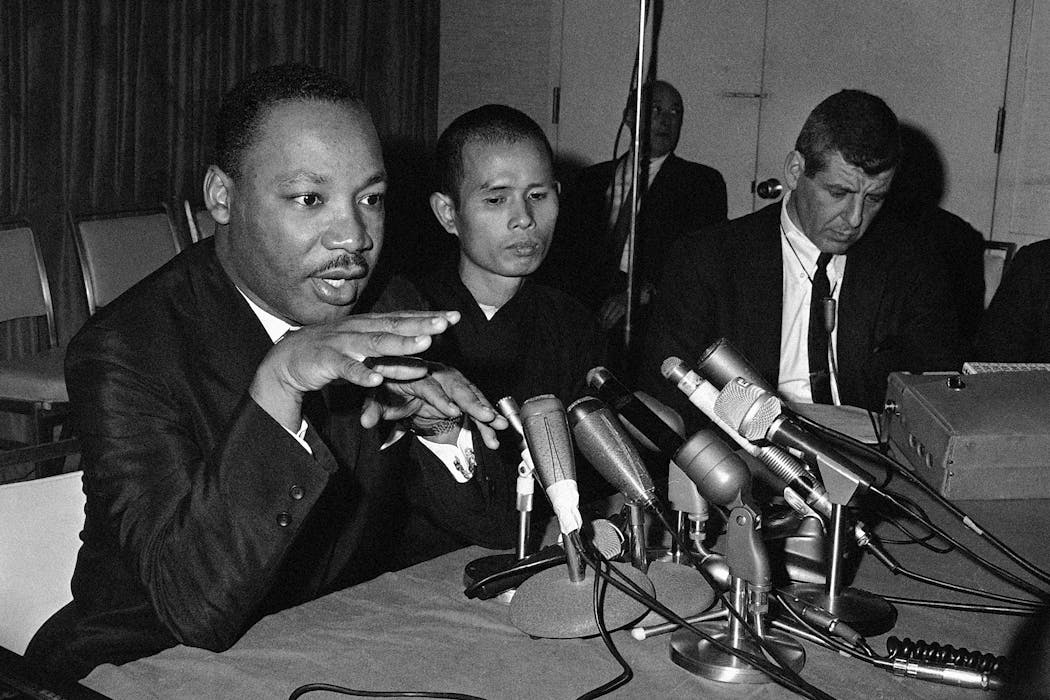
Before Martin Luther King Jr. was killed, he asked several of his friends to continue his life’s work building what he called “beloved community.” One of the people he invited was the Vietnamese Zen Buddhist monk, poet and mindfulness teacher Thich Nhat Hanh.
My new book, “On Mindful Democracy: A Declaration of Interdependence to Mend a Fractured World,” is inspired by King and Hanh’s friendship. These two men bonded over the shared insight that how we show up for each other matters, as does how we advocate for social change. In his sermon “Loving Your Enemies” King announced, “Hate cannot drive out hate, only love can do that.” Hanh taught: There is no way to peace, peace is the way.“
At the heart of beloved community is true democracy. To be agents of change who do not add to the suffering of the world, people must learn to become more loving and peaceful people.
‘The real enemies of man’
Hanh was born in 1926 in central Vietnam. As a young Buddhist monk living in a nation confronted by colonialism, conflict and war, he developed the doctrine of ”engaged Buddhism,“ premised on the belief that working to relieve suffering in the world is enlightenment.
During the mid-1960s, amid the Vietnam War – Vietnamese call it the “American War” – Hanh founded the School of Youth for Social Services to practice engaged Buddhism and help those affected by the bombs raining down on their homes.
On June 1, 1965, Hanh wrote a letter to King to raise awareness of the suffering of the Vietnamese people. He also hoped to correct some common misconceptions about Buddhism.
His overarching point was that Buddhists in Vietnam did not hate Americans. In fact, they did not hate anyone. Their goal was simply to bring an end to war – and an end to the delusions that led to war. “Their enemies are not man. They are intolerance, fanaticism, dictatorship, cupidity, hatred and discrimination which lie within the heart of man,” he wrote. “These are the real enemies of man – not man himself.”
Hanh refused to take a side during the war. He stood for peace. His peace activism earned him a 39-year banishment from his homeland.
Continuing King’s dream
Marc Andrus, author of the 2021 book “Brothers in the Beloved Community,” notes that King and Hanh met in person twice: once in Chicago, on May 31, 1966, and a second time in May 1967, at the World Council of Churches Peace on Earth Conference in Geneva, Switzerland. In Geneva, King shared his understanding of the beloved community with Hanh, inviting him to participate in its construction.
In between these two meetings, King nominated Hanh for the 1967 Nobel Peace Prize, writing in his nomination letter, “I know Thich Nhat Hanh, and am privileged to call him my friend.” No award was given that year, however, perhaps to protest King’s choice to make his nomination letter public. Nominations were typically private, but King used his to call out the injustice of the Vietnam War.
Hanh was crushed when he learned of King’s death in 1968. “I was in New York when I heard the news of his assassination; I was devastated. I could not eat; I could not sleep,” he later recalled. “I made a deep vow to continue building what he called ‘the beloved community’ not only for myself but for him also. I have done what I promised Martin Luther King Jr. And I think that I have always felt his support.”
Building ‘beloved community’
In the years after King’s murder, part of Hanh’s life work was devoted to fulfilling King’s dream and building the “beloved community.”
Beloved community is not an abstraction. It is a loose-knit global community composed of a multitude of smaller, local communities committed to practicing peace, nonviolence, freedom, love and justice. Emerging from King’s activism and Hanh’s engaged Buddhism, these communities are also committed to social change.
In 1982, Hanh and his student Sister Chan Khong established the Plum Village monastery in southern France. In the years since, the Plum Village community has founded dozens of monasteries around the world, including three in the United States: Blue Cliff in upstate New York, Deer Park outside San Diego, and Magnolia Grove in Mississippi.
Hanh’s lay students have established thousands of smaller Plum Village sanghas – communities – in North America and Europe. These monasteries and sanghas serve as practice centers where people learn to embody the ideals of beloved community in their mindfulness practice and daily lives.

Jeremy Engels, CC BY
Since the time of the Buddha, people committed to the path of mindfulness have agreed to live by a number of “precepts.” These precepts, typically numbering five, provide a moral foundation for action. Hundreds of thousands of people attending Plum Village retreats have agreed to live by the updated, secular version of the precepts that Hanh and his community wrote called the Five Mindfulness Trainings. These include: reverence for life, true happiness, true love, loving speech and deep listening, and nourishment and healing.
The Five Mindfulness Trainings are written to provide people with a practical path to building a shared life based in love, compassion, joy and peace: the type of life that both King and Hanh envisioned for all.
As Hanh told the global Plum Village community in a 2020 letter titled Climbing Together the Hill of the Century: “We have continued that aspiration of Dr. Martin Luther King Jr., and every day, our practice is to generate brotherhood and sisterhood, to cultivate joy and the capacity to help people. This is a concrete way to realize and continue that dream.”
On MLK Day, their friendship and writings are a reminder that democracy rests on the ability of citizens to be present for each other, to recognize their interconnectedness, to embody loving kindness and to disagree without resorting to violence.

Jeremy David Engels does not work for, consult, own shares in or receive funding from any company or organization that would benefit from this article, and has disclosed no relevant affiliations beyond their academic appointment.